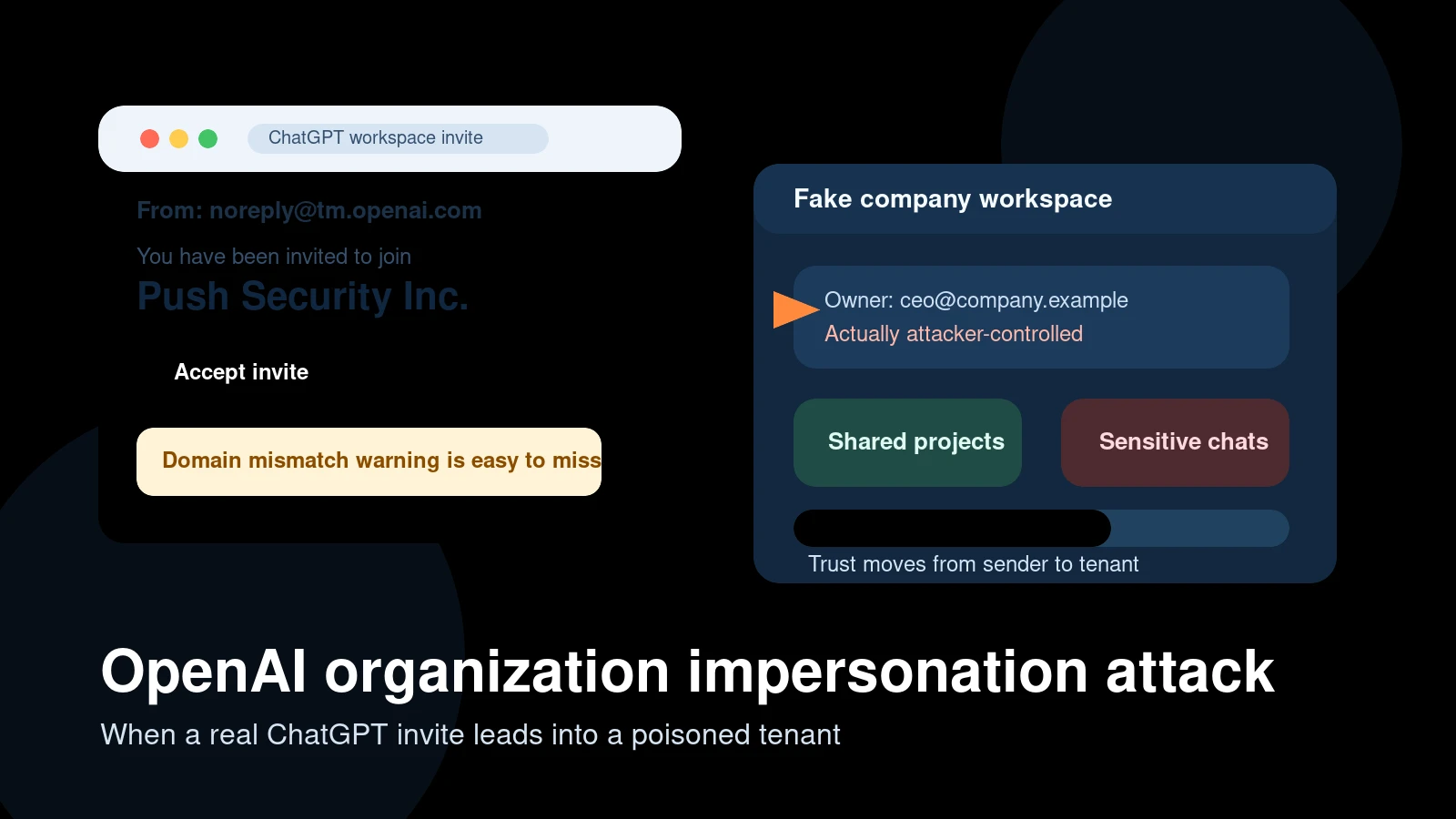
The OpenAI organization impersonation attack became a live public security story on June 26, 2026, when BleepingComputer reported that attackers were using legitimate ChatGPT workspace invitations to impersonate real companies. That date is the freshness gate for this post. Older poisoned-tenant research and OpenAI workspace documentation are supporting context, but the main hook is the June 26 public report.
That matters because this is not the old fake-login-page pattern most teams are trained to spot. The email can come from a real OpenAI notification address, pass normal mail authentication checks, and still lead the target into an attacker-controlled workspace that looks close enough to be believable. If your phishing training still starts and ends with "check the sender," you already have a gap.
Key Stat: According to the June 26 reporting, the invitation emails came from noreply@tm.openai.com and passed standard authentication checks, which is exactly why the campaign is more dangerous than ordinary brand-spoofed phishing.
Why the OpenAI organization impersonation attack matters now
The easy read is that this was a niche trick aimed at security people and therefore not a broad business issue. That is too narrow.
The OpenAI organization impersonation attack matters because it exploits a trust pattern that is spreading across modern SaaS: users are increasingly asked to join workspaces, projects, channels, tenants, and shared AI environments through email-driven workflows. Once people normalize that habit, a legitimate invitation can become a social-engineering surface all by itself.
This story also lands at a moment when teams are already overloaded with AI-related access decisions. Employees are trying new copilots, shared workspaces, internal prompt libraries, vendor-provided assistants, and third-party AI integrations faster than most identity teams can document them. That makes "join this workspace" feel routine, even when it should not.
The angle is different from Hexon’s earlier coverage of AI phishing lures using ChatGPT and Claude branding, OAuth app security reviews, ChatGPT lockdown mode, and Amazon Q workspace trust. Those posts focused on branding abuse, integration risk, prompt-injection controls, or local execution trust. This one is about tenant impersonation through a legitimate collaboration flow.
Key Takeaway: The core problem is not "fake OpenAI emails." The problem is that a real OpenAI workflow can still deliver an attacker-controlled environment.
How the poisoned-tenant pattern worked
The campaign surfaced after Push Security saw invitations sent to employees from a fraudulent OpenAI organization named to resemble the company itself. BleepingComputer describes the fake tenant as Push Security Inc., created by an attacker using Gmail accounts rather than the real company.
That detail matters because it shows how little friction an attacker may need if the platform allows flexible tenant creation and standard invitation mechanics.
The email looked legitimate because it was legitimate
This was not a forged sender-domain trick. The invitation was sent through OpenAI’s own notification system, which means the usual email checks most users are taught to rely on were not enough.
You can tell people to watch for typos, suspicious domains, or broken formatting. None of that helps much when the message is structurally normal and arrives through the vendor’s actual delivery path.
The fake workspace did the impersonation work
Once the target accepted, they were added to an attacker-controlled organization that mimicked the real company. According to the reporting, the workspace included an attacker account presenting as the victim company’s CEO, which immediately created pressure to treat the environment as legitimate.
That is why this is better understood as tenant impersonation than email phishing alone. The email only gets the person through the door. The fake workspace is where the deception becomes operational.
Administrative access increased the potential impact
Targets were reportedly assigned Owner privileges inside the bogus organization. That is an unusually telling choice.
Attackers were not just asking a victim to join a room and chat. They appear to have wanted the victim to enter a workspace where they had broad permissions and where the surrounding context implied internal collaboration. That raises the odds that a user might upload sensitive files, paste internal strategy, review projects, or interact with pre-positioned prompts and shared content as if it were part of normal work.
Common Mistake: Treating a workspace invitation as low risk because "it is only collaboration." In AI products, collaboration spaces often become containers for documents, prompts, project context, and internal discussions.
Why a real sender breaks standard phishing training
Most awareness guidance still assumes the main defensive move is to spot an external fake. That logic breaks when the vendor’s own system is part of the delivery chain.
This is where the story becomes useful beyond OpenAI itself. Any platform that lets outsiders create tenants and invite your users can generate the same category of trust failure:
- a legitimate sender
- a realistic tenant name
- a target list based on research
- a workflow users already recognize
- a collaboration space that looks official enough
In other words, the attacker borrows the platform’s reputation instead of counterfeiting it.
That makes the campaign especially relevant for organizations using shared SaaS platforms with weak domain verification, flexible member invites, or permissive cross-tenant collaboration. It also connects to older Push Security research on poisoned tenants, where the wider lesson was that identity and collaboration features can be repurposed as attack infrastructure.
The OpenAI angle simply makes the risk more immediate because employees increasingly assume AI workspaces are normal business tooling, not a special-case environment requiring extra skepticism.
Pro Tip: Update phishing guidance from "check the sender" to "verify the relationship and ownership behind the workspace." Those are not the same thing.
What data or access attackers are probably after
The June 26 reporting does not need to prove full downstream compromise to be important. The structure of the attack already suggests what an adversary likely wants.
If a target joins a fake AI workspace that appears internal, the attacker may be trying to capture:
- sensitive project discussions
- pasted credentials or tokens
- internal planning documents
- customer or prospect information
- product strategy or incident details
- trust that can be used for a follow-on attack
That last point is easy to underrate. Even if the first session produces nothing dramatic, the attacker may now know which users accept the invite, how they behave inside the workspace, what they ask, and whether they can be steered toward additional actions.
For security teams, this is what makes the campaign feel closer to a workflow compromise than a one-shot phishing email. The fake tenant is a staging area for continued interaction.
It also overlaps with the logic behind account recovery security and OAuth app security. Once attackers gain a convincing place inside your trust graph, they do not need to steal a password immediately. They can wait for the user to volunteer useful context.
What defenders should do in the next 24 hours
This is a good case for tightening procedure, not writing another generic "be careful with AI" memo.
1. Treat AI workspace invites like SaaS access requests
If an employee gets invited to a ChatGPT Business or Enterprise workspace, require verification through a second channel before acceptance unless the workspace is already expected.
That means checking with the internal owner in Slack, Teams, email, or ticketing, not trusting the invite by itself. A real vendor email is no longer enough evidence.
2. Review whether your domains are verified and discoverable
OpenAI’s help documentation on managing members and roles in ChatGPT Business and related workspace controls should be part of the admin review. If a platform supports domain verification, SSO enforcement, or stricter invite governance, use it.
The practical question is simple: can a user tell the difference between a company-controlled workspace and an outsider-created lookalike before they join? If the answer is "not reliably," your process is weak.
3. Harden employee guidance around shared AI workspaces
Tell people explicitly:
- do not accept unexpected AI workspace invites
- do not upload internal files into a newly joined workspace
- do not assume a real sender means a real company owner
- do not trust a familiar company name without verifying the admin behind it
That guidance is boring. It is also likely to work better than abstract warnings about AI risk.
4. Inventory where AI collaboration is already allowed
Many teams already have shadow AI sprawl. If employees are using multiple assistants, they may not know which one is company-approved and which one is not.
List the sanctioned AI workspaces, who owns them, and how invites should normally happen. If people cannot compare a new invite against a known-good list, they are stuck making a guess under time pressure.
5. Watch for invite-based social engineering in other platforms
Do not scope this defense only to OpenAI. The same pattern can apply to:
- project management tools
- knowledge bases
- design platforms
- developer collaboration suites
- CRM integrations
- other AI copilots with shared workspaces
Once one vendor demonstrates the pathway, copycats usually follow.
Key Stat: OpenAI’s own help center notes that workspaces have members, roles, seat types, and invite flows. That is normal product design. It also means the attack surface now includes organizational workflows, not just chats.
How to adapt your security model for tenant impersonation
The bigger lesson here is that SaaS trust decisions have to move up a level. For years, defenders focused on whether a login page or sender domain was fake. That still matters, but it is no longer enough.
The more relevant question is: who controls the tenant, workspace, or organization on the other side of the invitation?
That change pushes security teams toward a slightly different operating model:
- verify tenant ownership, not only sender authenticity
- document approved AI workspaces, not only approved apps
- watch for unusual invitations, not only malicious links
- treat collaboration contexts as data-handling zones, not casual chat rooms
This is where AI adoption complicates the picture. Employees often assume the dangerous action is entering a password. In reality, modern collaboration attacks increasingly want something softer and more abundant: context.
Context means the documents you paste, the names you mention, the internal prompts you reuse, the projects you open, and the people you trust once the environment feels familiar. That is why a poisoned tenant can be so effective even before any classic credential theft happens.
Final takeaway
The freshness gate for this post is BleepingComputer’s June 26, 2026 publication on fraudulent OpenAI organization invites. Push Security’s earlier poisoned-tenant research and OpenAI’s workspace documentation are supporting context only.
For defenders, the message is direct: the OpenAI organization impersonation attack shows that a legitimate ChatGPT invite can still be phishing when the attacker controls the workspace behind it. If your team still treats sender reputation as the main trust signal, you are defending the inbox while the real deception has already moved into the tenant.