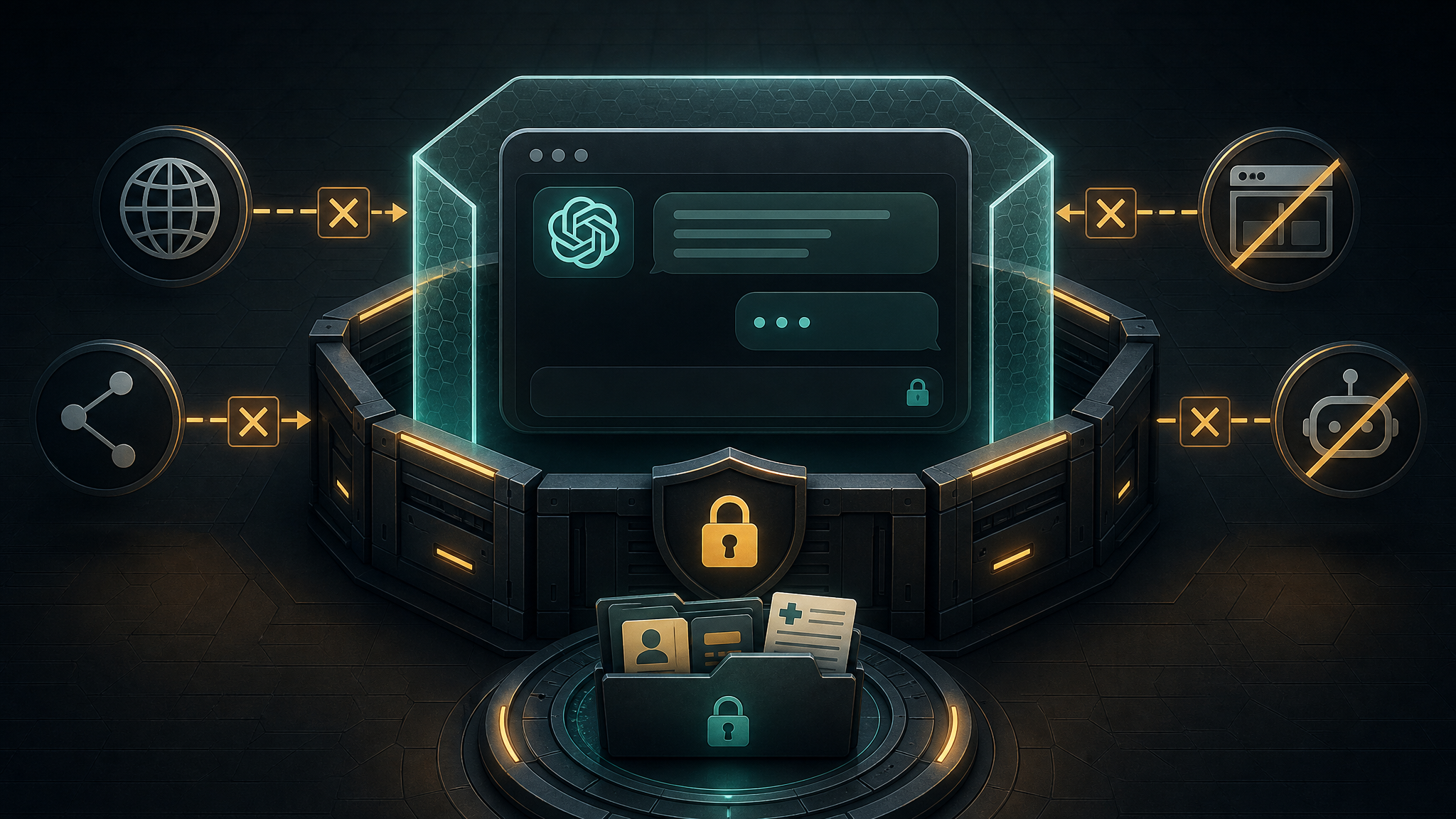
ChatGPT Lockdown Mode is one of the more important AI security releases of the week because it accepts an uncomfortable truth out in the open. On June 8, 2026, fresh public reporting showed OpenAI rolling out an optional mode that deliberately turns off or constrains some of ChatGPT's most useful internet-connected features in order to reduce prompt injection driven data theft. That matters right now because the market has spent months talking about better guardrails while still shipping products that could browse, connect, and act with too much freedom around sensitive data.
If your team uses ChatGPT for research, analysis, or internal workflows, this is the real takeaway: OpenAI is no longer pretending the model alone can solve the problem. It is starting to contain the blast radius at the product layer.
Why ChatGPT Lockdown Mode is the freshness hook
The main hook here is the June 8, 2026 public rollout coverage from Help Net Security, paired with OpenAI's live Lockdown Mode documentation. Not older prompt injection theory, not older model safety claims, and not older debates over whether browsing agents should be trusted by default.
That distinction matters because this is a product decision, not just a research paper or a vague roadmap promise. OpenAI is effectively saying that for some users, the safest version of ChatGPT is the version with less live reach into the outside world.
Key Takeaway: The significance of ChatGPT Lockdown Mode is not that OpenAI discovered prompt injection is dangerous. It is that OpenAI is now shipping a user-facing containment mode that assumes prompt injection fallout has to be managed even when prevention is incomplete.
Recent Hexon coverage already pointed in this direction. AI agent security scoring showed how rarely agent capability and containment line up cleanly in practice. 1Password and OpenAI's credential-boundary work made a similar point from the secrets side: the safest system is often the one that never gives the model custody of sensitive material in the first place.
What ChatGPT Lockdown Mode actually changes
The feature is meaningful because it trades convenience for containment in specific, operational ways.
According to OpenAI's help documentation, Lockdown Mode limits or disables several capabilities that create outbound pathways from ChatGPT to the web or external services. That includes:
- live web browsing, which is restricted to cached content
- deep research, which is disabled
- agent mode, which is disabled
- networked Canvas actions, which cannot be approved
- file downloads for data analysis, which are blocked
- live connector access and write actions, which are constrained depending on workspace controls
That is a sharper posture than most AI product releases take. Usually the market celebrates more reach, more connectors, more autonomous action, and fewer interruptions. Lockdown Mode does the opposite. It admits that some of those capabilities become liabilities when the user is handling sensitive information and the model is exposed to untrusted content.
This is also why the feature stands apart from older generic "enterprise-grade security" claims. OpenAI is not just promising better monitoring. It is removing classes of behavior that make data exfiltration easier.
Key Stat: In Lockdown Mode, OpenAI disables both Deep Research and Agent Mode outright. That is a strong signal that the company sees autonomous or semi-autonomous networked actions as a meaningful part of the exfiltration problem, not just a side issue.
If you want the simplest mental model, use this one: ChatGPT Lockdown Mode is trying to block the last dangerous hop in an attack chain, where a hostile document, page, or connector result persuades the system to send sensitive information somewhere it should not go.
Why prompt injection still drives the whole conversation
The deeper value of this launch is what it says about the current state of prompt injection defense.
OpenAI's own materials are fairly direct. Lockdown Mode helps reduce the risk of data exfiltration from prompt injection attacks by limiting outbound requests. That wording matters because it is more honest than a lot of AI product messaging. It does not claim prompt injection has been solved. It claims the downstream consequences can be made harder to realize.
That is the right framing.
Prompt injection is not just a "bad answer" problem. In modern AI products, it becomes a workflow problem. Once the system can browse, query apps, inspect connected sources, generate code, download artifacts, or take actions on the user's behalf, malicious instructions embedded in otherwise normal content can become a route to unwanted behavior.
This is exactly why older defensive instincts are no longer enough. Content filtering matters. Model tuning matters. But if the system still has a clean path from hostile input to outbound action, you are relying on the model to stay perfect under pressure.
Hexon has hit this from multiple angles already. The prompt injection defense guide explained why instruction hierarchy alone is weak against creative indirect attacks. The AI agent visibility crisis showed what happens when organizations cannot see which agents are connected to what data and which tools.
Lockdown Mode fits that same pattern. The smarter move is not only "make the model wiser." The smarter move is "give the model fewer risky ways to act when you know the input cannot be fully trusted."
Common Mistake: Treating prompt injection as a content moderation problem. Once the system can browse, connect, write, or retrieve on your behalf, prompt injection becomes a runtime containment problem too.
Who should use ChatGPT Lockdown Mode first
OpenAI says Lockdown Mode is not intended for everyone, and that is probably correct. If you turn it on casually, parts of ChatGPT will feel worse. Search may be stale. Research tasks may be weaker. Agentic workflows disappear. Some app experiences stop being useful.
That does not make the feature niche. It makes it targeted.
The best early candidates are the users and teams whose downside risk is much higher than their need for maximum convenience:
- legal teams reviewing confidential materials
- finance teams handling deal, payroll, or forecasting data
- executives and chiefs of staff using AI around sensitive planning
- security teams testing AI-assisted workflows against internal data
- regulated businesses that want a narrower path before broader rollout
- small companies that allow ChatGPT use but do not want every feature enabled by default
For those groups, ChatGPT Lockdown Mode offers something the broader AI market often skips: a deliberate middle ground between "ban the tool" and "let the tool do everything."
What admins should evaluate before enabling it
The admin story matters almost as much as the end-user toggle.
OpenAI's docs make clear that connectors, apps, MCP access, and write actions still require careful workspace policy decisions. Lockdown Mode does not magically sanitize every integration. It narrows what is possible, but administrators still have to think about which apps are trusted, which actions have side effects, and who can view the outputs of those actions.
That is a welcome design choice because it forces the real governance question back onto the table:
- Which sources are safe enough to sync?
- Which live connections are worth the residual risk?
- Which write actions create visible or irreversible side effects?
- Which users actually need those capabilities?
If your organization cannot answer those questions, enabling every connector and hoping the model behaves is still a bad plan.
Where defenders could still misread the feature
Lockdown Mode is a strong signal, but it is not a universal fix.
First, the feature does not stop prompt injection from appearing in content. OpenAI says that directly. Cached content, uploaded files, and other inputs can still contain hostile instructions. The mode reduces the chance that those instructions end in data exfiltration, but it does not make the model incapable of being influenced.
Second, it does not change everything about data handling. Memory, file uploads, conversation sharing, and training-related settings are governed separately. That means teams still need policy discipline around what they upload, what they retain, and which workspace settings remain active.
Third, this is still a tradeoff product. Users who need rich external action paths will feel the restrictions immediately. In practice, that means some organizations may need separate usage tiers:
- a more locked-down profile for sensitive work
- a broader profile for low-risk research and experimentation
- a stricter review process for connector-enabled or agent-enabled use cases
That segmentation is healthy. It is also a sign of where AI security is heading. We are moving away from one flat trust model for all users and all actions.
Pro Tip: If your team is unsure where to start, enable ChatGPT Lockdown Mode first for the users who routinely paste the most sensitive information into AI tools, not for the users who complain the loudest about reduced convenience.
Why ChatGPT Lockdown Mode matters beyond ChatGPT
This story earns today's slot because it says something broader about the AI security market.
For months, the industry has been caught between two bad habits. One side kept speaking as if smarter models would eventually dissolve the prompt injection problem. The other side reacted by arguing that meaningful AI automation around sensitive data was simply too risky to use. Both positions miss the operational middle.
ChatGPT Lockdown Mode points to a more realistic direction:
- assume hostile instructions will sometimes get in
- reduce the set of reachable external actions
- downgrade live connectivity when the risk is high
- separate high-sensitivity users from convenience-first users
- give admins clearer control over apps, connectors, and writes
That is not a full zero-trust architecture for AI products, but it is closer than a lot of the market has been willing to go publicly.
It also creates competitive pressure. If OpenAI is willing to disable high-risk product features in the name of safer deployment, other AI vendors will have a harder time defending "full autonomy everywhere" as the default security posture. That pressure will likely spill into procurement too. Buyers are going to start asking which products have a comparable restricted mode, which connectors can be policy-scoped, and how the vendor handles outbound requests under hostile-input assumptions.
In that sense, this is not just a product update. It is an admission that the next stage of AI adoption depends on security posture differentiation, not just model quality differentiation.
The bigger architectural lesson
The most important lesson here is simple: when prevention is imperfect, containment has to become a feature.
That lesson has already shown up across the AI stack. We saw it in runtime isolation for coding agents. We saw it in credential brokerage that keeps secrets out of model context. We saw it in new attempts to score agent blast radius, not just model capability. Now we are seeing it in a mainstream consumer and business AI product that is explicitly willing to do less in order to leak less.
That is a useful correction.
Too much AI product design has been built around the idea that more access equals more value. Sometimes that is true. But in security terms, more access also means more routes to misuse, more opportunities for coercion, and more ways for untrusted input to turn into a meaningful business problem.
ChatGPT Lockdown Mode does not solve all of that. What it does is more practical. It gives organizations a deployable way to shrink the action surface for sensitive use cases today.
Final takeaway
The main reason ChatGPT Lockdown Mode matters is that it treats prompt injection as a product-boundary problem, not just a model-behavior problem.
The June 8 rollout shows OpenAI moving toward a harder but healthier truth for AI security: if a system handles sensitive data and touches the outside world, the safe default may need to be less browsing, fewer connectors, weaker autonomy, and more deliberate containment.
That is not flashy. It is not the kind of release that demos well on stage. But it is exactly the kind of release that makes enterprise AI adoption more defensible.
If this direction holds, the most trusted AI products in the next year will not be the ones that can do absolutely everything by default. They will be the ones that make it easiest to decide, verify, and enforce what the model is not allowed to do when the stakes are high.