The Amazon Q Developer vulnerability became a live public security story on June 26, 2026, when The Hacker News translated Wiz's earlier technical findings into a broader warning for defenders. That publication date is the freshness gate for this post. Wiz's research and AWS's security bulletin are supporting context. The reason this is worth publishing today is that the public hook is now fresh, mainstream, and operationally relevant.
That matters because this was not a niche parser bug buried in a forgotten plugin. It was a trust-boundary failure in an AI coding assistant that could let a malicious repository trigger local command execution and expose a developer's live cloud session. When the assistant sits inside the IDE, "opening a workspace" is no longer a low-stakes action.
Key Stat: AWS says the issue affected Language Servers for AWS before version 1.65.0, while its June 23 bulletin recommends moving to version 1.69.0 because that build also fixes a second related trust-boundary issue, CVE-2026-12958.
Why the Amazon Q Developer vulnerability matters now
The lazy read is that this is just one more IDE flaw and the patch already exists. That misses the real lesson.
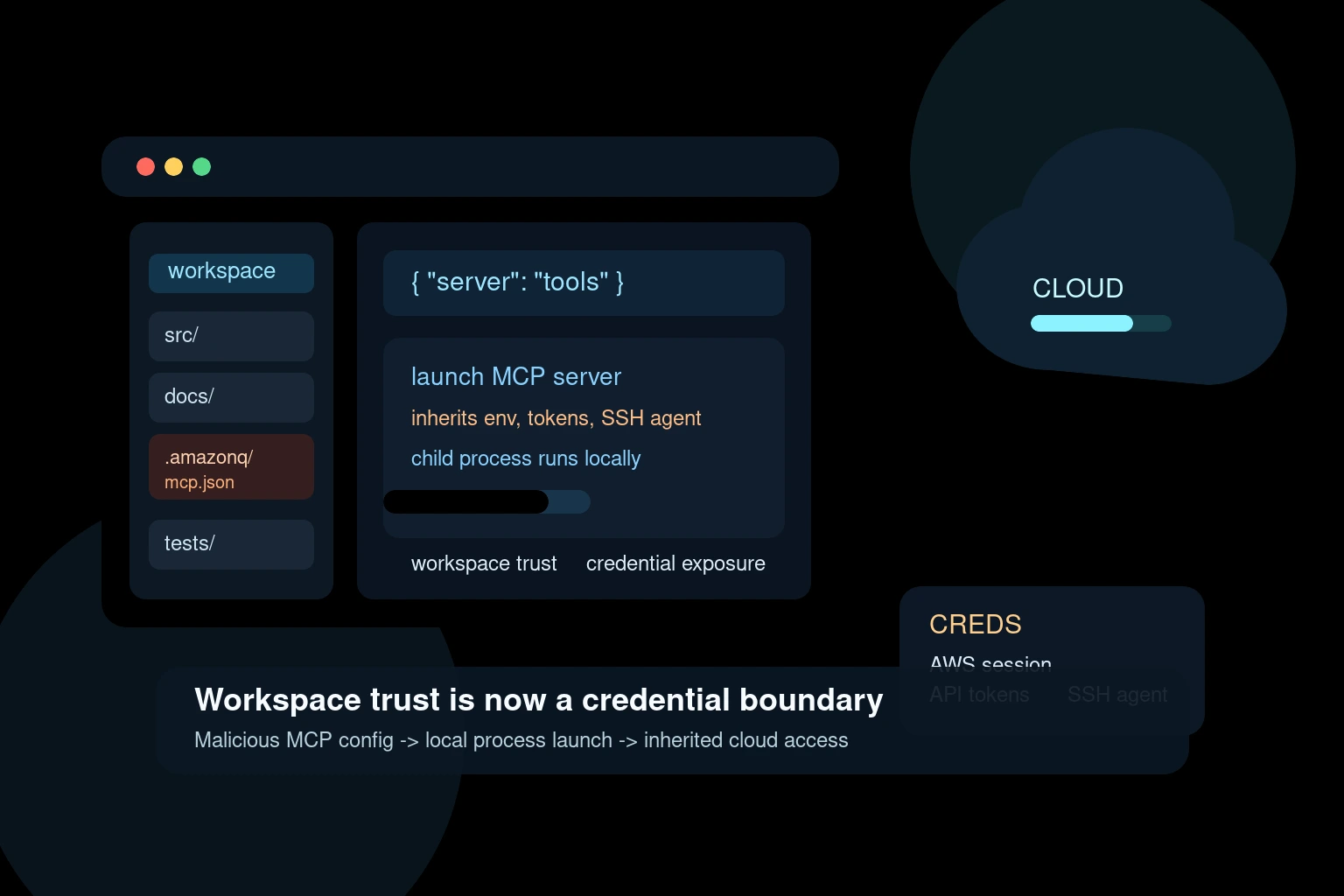
The Amazon Q Developer vulnerability matters because it shows where AI coding risk is consolidating: not only in model output quality, but in the thin layer where repository content becomes executable tool behavior. In this case, a workspace file could define MCP servers, Amazon Q would launch them, and those spawned processes inherited the developer's environment.
That is a bigger problem than a normal local bug. Developers often carry active AWS sessions, API tokens, SSH agent sockets, internal network reachability, and production-adjacent permissions. If an attacker can turn a repository into a code-execution path inside that context, the leap from code clone to cloud compromise gets uncomfortably short.
This is why the story fits alongside Hexon's earlier coverage of ChatGPT lockdown mode, Claude Code security guidance, TrapDoor's attack on AI developer tooling, and Cursor's developer workstation compromise. The repeated pattern is that AI tooling keeps collapsing the distance between convenience, trust, and execution.
Key Takeaway: This is not mainly an Amazon story. It is a story about how quickly "helpful project configuration" can become "attacker-controlled process launch" inside modern coding agents.
How the Amazon Q Developer vulnerability worked
According to Wiz's technical write-up, the vulnerable behavior centered on .amazonq/mcp.json inside the workspace. Amazon Q used that file to discover and launch Model Context Protocol servers.
That sounds ordinary until you remember what an MCP server actually is. It is not a harmless settings object. It is a local process the assistant can spawn so it can reach tools, APIs, build systems, databases, or other runtime capabilities.
Workspace config crossed the trust boundary
Wiz says Amazon Q automatically loaded the workspace MCP configuration and executed the defined server path without a separate server-specific approval step. In practice, that meant a developer could clone a repository, open the folder, trust the workspace, and let the assistant do the rest.
That trust sequence is the real issue. A repository is untrusted input until a human has reviewed it. Turning repository-carried config into running local processes before the user has meaningfully evaluated what the config wants to do is exactly how a trust boundary fails.
Environment inheritance raised the impact
The launched process inherited the developer's environment. That is where a local execution bug becomes a cloud security story.
Wiz's proof of concept used aws sts get-caller-identity to capture the active AWS session and send it outward. The same design pattern could expose environment variables, CLI tokens, or other secrets available to the assistant's child process. If the victim has elevated cloud access, the post-exploitation value rises fast.
The flaw did not need exotic user behavior
The uncomfortable part is how routine the trigger looks. Developers clone repositories constantly. They open pull requests, test examples, inspect third-party packages, and review interview or take-home code all the time.
That is why this is strategically stronger than a bug that depends on an obviously reckless action. The vulnerable path sat inside normal workflow behavior that many teams have already trained themselves to consider safe enough.
Common Mistake: Treating workspace trust prompts as if they are equivalent to code review. They are not. A prompt is a moment of consent, not a moment of comprehension.
Why workspace trust is the real cloud security issue
Plenty of security teams still model developer endpoints and cloud identities as separate control problems. AI coding assistants are making that separation less real by the month.
When a coding tool can read repo files, spawn helper processes, inherit credentials, and reach external services, it becomes a bridge between source code and operational access. That bridge is useful. It is also exactly what attackers want.
The AWS bulletin frames the issue as improper trust-boundary enforcement in Language Servers for AWS. That wording is more important than it looks. The defect was not only "bad command execution." It was that the product treated attacker-controlled workspace content as sufficiently trusted to define behavior inside a high-privilege developer session.
This is why AI coding assistants deserve a different review standard than classic autocomplete. Once the tool can execute, inspect, or connect, the security question changes from "can it suggest vulnerable code?" to "what ambient privileges does it inherit when it acts?"
That same concern sits underneath broader Hexon themes like AI agent security scoring and Dify cross-tenant exposure. In each case, the dangerous layer is the operational glue around the model, not the model by itself.
Pro Tip: If your developers use AI coding tools with cloud credentials loaded, treat repository trust, plugin trust, and tool-execution trust as one security control plane, not three separate checklists.
What AWS fixed and what defenders should notice
AWS's bulletin says CVE-2026-12957 was remediated in Language Servers for AWS 1.65.0, but recommends customers upgrade to 1.69.0 because that newer release also fixes CVE-2026-12958, a missing symlink-validation flaw that could allow file writes outside the workspace trust boundary.
That recommendation matters for two reasons.
First, it means the safest operational message is not "patch the one headline CVE." It is "move to the current fixed build chain." Security teams that aim for the narrow minimum often leave adjacent trust problems in place.
Second, it highlights how these issues travel across the plugin ecosystem. AWS says the language-server runtime powers Amazon Q across VS Code, JetBrains, Eclipse, and Visual Studio. One trust-boundary mistake in the shared runtime can spread across multiple developer surfaces at once.
There is also an encouraging detail worth keeping in scope: the public reporting says there is no known public exploitation at this stage. That gives defenders a cleaner patch window than in many 2026 security stories. But it does not reduce the structural lesson. If the exploit path is straightforward and the affected environment is valuable, eventually someone will test it at scale.
What security teams should do in the next 24 hours
This is a good day for a focused cleanup, not a vague discussion about AI policy.
1. Upgrade the affected Amazon Q components
Move teams to the latest plugin releases that bundle the remediated language server. AWS lists minimum fixed plugin versions across the major IDEs, and its own guidance points customers to the latest available release train.
Do not stop at a package inventory spreadsheet. Validate that the update actually landed on developer endpoints and that auto-update behavior is not blocked by internal controls or proxy policies.
2. Review where AI coding tools inherit credentials
Map what an assistant process can see when it launches child commands. Check AWS credentials, other cloud tokens, API keys, SSH agent forwarding, internal certificate stores, and VPN-mediated network reachability.
If the tool can execute locally, anything in that inherited environment is part of the blast radius.
3. Tighten repository trust habits
Treat third-party repositories, unsolicited pull requests, interview projects, and newly cloned internal repos as untrusted until reviewed. That should be explicit team practice, not only an individual instinct.
For high-risk workflows, require developers to inspect config directories and agent-specific files before activating AI assistant features in a fresh workspace.
4. Audit MCP usage across coding tools
Amazon Q is not the only product that has tripped over MCP trust. If your teams use multiple coding assistants, inventory where MCP server definitions can live, whether they can be loaded from a project, and what approval path exists before execution.
You do not need the bugs to be identical for the risk to rhyme.
5. Revisit workstation-to-cloud segmentation
This story is another reminder that the developer laptop is often a cloud control surface. Reduce standing privileges where possible, shorten credential lifetimes, and separate high-risk experimentation from production-capable sessions.
If a repo-triggered local process can reach production credentials, the workstation is already too trusted.
Key Stat: AWS says there are no workarounds for these issues, which is a useful forcing function. This is an upgrade-and-validation problem, not a policy toggle you can lean on for a month.
The broader lesson for AI coding security
The strongest posts in this category are not the ones that scream the loudest about a single CVE. They are the ones that clarify what the next class of failures will look like.
The Amazon Q Developer vulnerability points to a simple rule teams should adopt now: repository-provided agent configuration is hostile input until proven otherwise. If a coding assistant treats project files as launch instructions, tool registration, or network behavior changes, those files deserve the same skepticism you would apply to a shell script.
That does not mean AI coding tools are unusable. It means their convenience features have finally reached the point where they deserve mature trust design. Prompt approvals, workspace trust, MCP server consent, child-process inheritance, and cloud credential handling all need to line up. When one of those pieces is loose, the attacker gets an opening.
The teams that adapt fastest will stop treating AI coding security as a model-behavior problem alone. They will treat it as a runtime trust problem with real identity and execution consequences.
Final takeaway
The freshness gate for this post is The Hacker News publication on June 26, 2026. Wiz's earlier research and AWS's June 23 bulletin were used only as supporting context after today's public report cleared the gate.
For defenders, the message is clear. The Amazon Q Developer vulnerability is not just a patched IDE bug. It is a warning that workspace trust inside AI coding assistants now sits directly on top of cloud identity, local execution, and developer privilege. If your organization treats those as separate problems, the attacker only needs one cloned repository to prove otherwise.