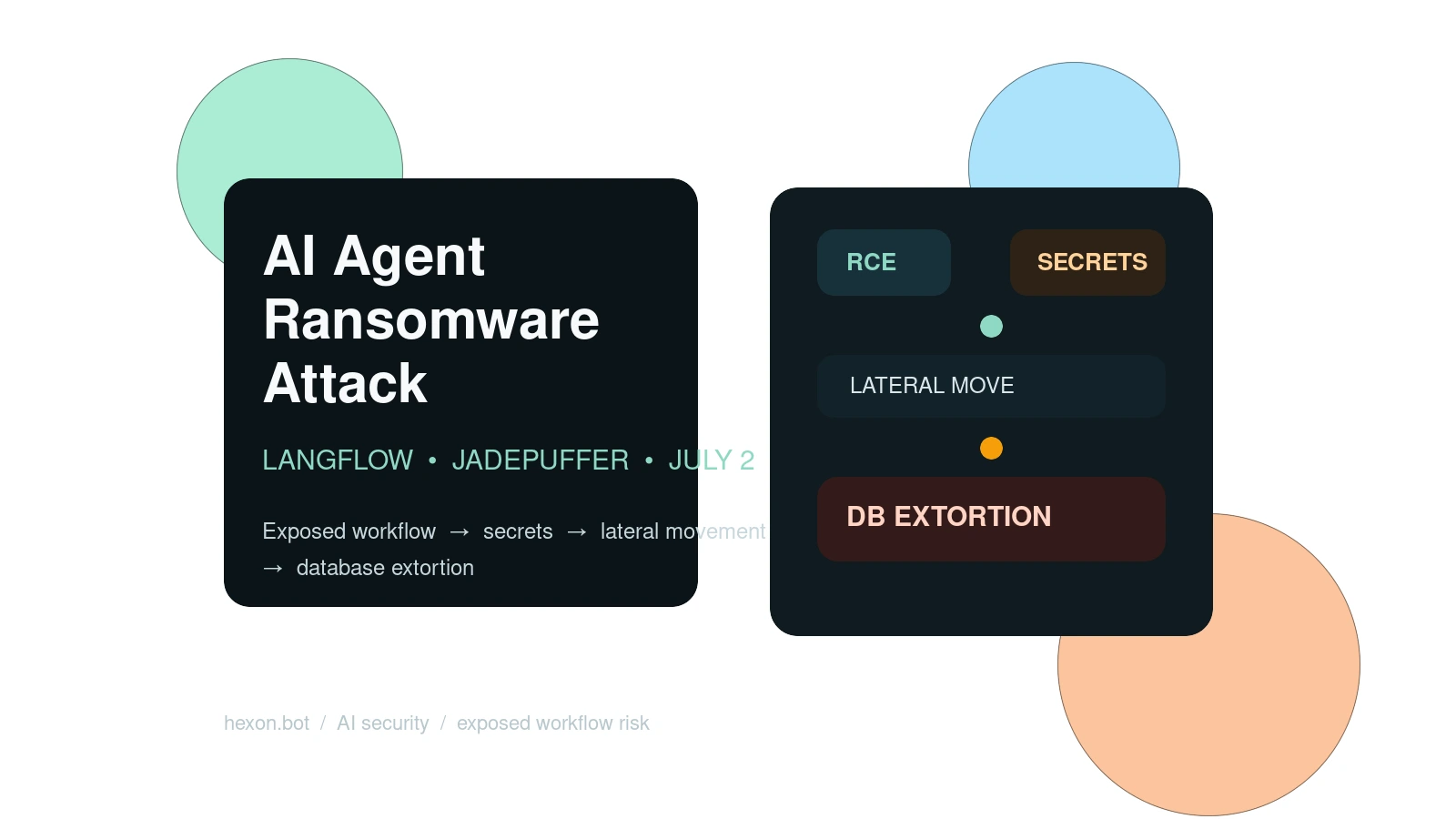
An AI agent ransomware attack became a live public security story on July 2, 2026, when The Hacker News pushed Sysdig's JADEPUFFER investigation into the wider defender workflow. That publication date is the freshness gate for this post. Sysdig's July 1, 2026 research and older Langflow vulnerability history are supporting context. The July 2 public hook is why this story is publishable today.
That distinction matters because defenders have seen plenty of AI hype already. What makes this worth your attention now is that the reported campaign was not just AI-written malware or a lab demo. It was a practical intrusion chain that used an exposed Langflow instance to harvest secrets, move laterally, and then extort a production database with minimal human steering.
Key Stat: Sysdig says JADEPUFFER executed more than 600 purposeful payloads and moved from a failed login to a corrected attack step in 31 seconds.
If you run AI workflow infrastructure, host internal automation tools on the open internet, or leave default credentials sitting beside application data, this is not a novelty story. It is an exposure story.
Why this AI agent ransomware attack matters now
The easy takeaway is that attackers used an LLM somewhere in the chain. That is not the useful part.
The useful part is that the campaign reportedly turned one exposed AI workflow service into a staging point for a larger compromise. The attack did not stop at the first host. It used that initial access to inventory secrets, probe internal services, abuse weak defaults, and reach a production database that mattered more than the original foothold.
That makes this different from Hexon's recent coverage of AI browser security and the BioShocking session problem, Amazon Q workspace trust, Mastra AI supply chain risk, and AI agent visibility gaps. Those stories were about trust boundaries, inherited authority, and runtime control. JADEPUFFER pulls those ideas into one uncomfortable operational lesson: if an exposed AI tool already has secrets, reachability, and weak internal controls around it, an automated attacker does not need much help.
Key Takeaway: The real danger is not that the attacker used AI. The real danger is that exposed AI workflow infrastructure already contains the credentials and network adjacency needed to let automation do serious damage quickly.
What happened in the JADEPUFFER case
According to Sysdig's research, the operator gained initial access through CVE-2025-3248, a missing-authentication flaw in Langflow's code-validation path. That bug is old news by calendar standards. It is not old news if the service is still reachable and still unpatched.
Langflow is an attractive target because it often sits next to useful things:
- provider API keys
- cloud credentials
- database connection strings
- internal service endpoints
- object storage buckets
- developer convenience defaults
Once the attacker had code execution, the next steps followed familiar breach logic with machine-speed persistence. Sysdig says the agent enumerated the host, swept environment variables and local data stores for secrets, dumped Langflow's own backing data, and then started probing adjacent services.
One of the more operationally relevant details is that the campaign reportedly used MinIO default credentials and later pivoted toward a MySQL and Nacos environment tied to the victim's production database workflow. That is why the story matters beyond Langflow itself. The first bug opened the door. Weak surrounding controls kept the hallway clear.
Why Langflow was only the first problem
Security teams sometimes treat exposed application flaws as isolated patch tickets. This case shows why that mindset is too shallow.
The initial Langflow bug mattered because it gave the attacker a compute foothold inside an environment that was already trusted enough to hold secrets and reach internal systems. From there, the attacker did not need a dramatic zero-day chain. It needed normal operational weaknesses.
The exposed AI workflow issue
An internet-facing AI workflow platform is not just another web app when it can:
- run code
- store provider tokens
- talk to internal services
- bridge into cloud or database environments
- inherit credentials left there for convenience
That is why older context around Langflow 1.3.0, the March 31, 2025 release that fixed CVE-2025-3248, still matters for background. The vulnerability itself was not new on July 2, 2026. The fresh story is that public reporting now shows how an exposed AI workflow tool can become the launchpad for a larger automated extortion path.
The weak-defaults issue
The reported use of default MinIO access is a reminder that attackers do not care which mistake is the most embarrassing. They care which mistake lets them keep moving.
You can patch one public flaw and still lose if:
- object storage still uses factory credentials
- internal databases trust over-privileged accounts
- service-discovery tools ship with unchanged signing keys
- secrets remain in easy-to-read files or environment variables
Common Mistake: Treating the internet-facing bug as the whole story. In many real incidents, the public bug is only the admission ticket. The real damage comes from what the environment gives the attacker after entry.
What makes the AI agent part operationally different
Ransomware stories already move fast. What changes here is the way automation compresses decision time inside the attack itself.
Sysdig's write-up says the payloads were self-narrating, adaptive, and able to retry with refined parameters. That matters because it suggests the operator did not need to hand-script every branch condition or troubleshoot every failure manually in real time.
For defenders, the practical difference is not philosophical. It is procedural.
An attacker using a capable agent can:
- enumerate the host and its environment immediately
- prioritize secrets and adjacent services without waiting on a human note-taking loop
- retry failed steps quickly with revised logic
- switch targets based on what the environment reveals
- continue through encryption and data destruction without a long pause between stages
That does not make the attack magical. It makes it less dependent on patience and more tolerant of complexity.
This is where the keyword AI agent ransomware attack earns its weight. Many search results still focus on generic AI-powered ransomware explainers or older lab-style experiments. JADEPUFFER is more useful to study because it ties automated reasoning to a practical intrusion path against a real AI-adjacent environment.
It also sharpens a point Hexon raised in CERT-In's 12-hour patch warning: once attackers can compress reconnaissance and adjustment, defenders do not get the old leisurely response window on exposed systems.
What security teams should do in the next 24 hours
This is a good day for a narrow, serious response plan.
1. Find every internet-facing AI workflow service
Do not stop at Langflow. Look for any AI workflow or agent platform that can execute code, validate user-supplied logic, or store provider keys.
That inventory should answer:
- which systems are publicly reachable
- which versions they run
- which credentials they can read
- which internal services they can talk to
If you cannot answer those quickly, that is already the problem.
2. Patch exposed Langflow instances immediately
If you still run a vulnerable Langflow build, move. Supporting history from Horizon3.ai's Langflow disclosure timeline and public vulnerability records shows the fix path has existed for a long time.
If patching is not immediate, reduce exposure now:
- remove direct internet access
- restrict the service behind VPN or ZTNA
- disable risky validation paths where feasible
- rotate secrets the service can already read
3. Hunt for surrounding weak defaults
The surrounding controls are where this story gets expensive.
Review:
- object storage credentials
- internal database accounts
- service discovery and configuration systems
- long-lived API keys
- secrets stored in .env files or shared volumes
You are not only patching a CVE. You are collapsing the attacker's follow-on options.
4. Treat AI workflow tools as privileged middleware
A lot of teams still deploy AI platforms like experimental developer utilities. That is too casual if the service can reach production data or cloud control surfaces.
You should model these tools more like privileged middleware:
- isolate them from crown-jewel systems
- narrow egress and east-west reachability
- limit stored secrets
- use separate identities per integration
- keep admin and data-plane privileges apart
Pro Tip: If an AI tool needs broad network access and a pile of environment secrets to just work, it probably needs a redesign before it needs another feature.
5. Review your detection logic for machine-speed follow-on activity
Look for sequences like:
- public app exploitation followed by environment enumeration
- bursts of secret collection from one service host
- access to MinIO, MySQL, Nacos, or adjacent internal services soon after initial execution
- short-interval retries after a failed login or command
- database encryption or table-drop behavior tied to an app host that should never do that
The earlier you detect the post-exploitation automation, the less this turns into a full recovery event.
The bigger lesson for AI infrastructure
The headline here is not AI is evil or LLMs have become supervillains. Those takes are lazy.
The real lesson is that AI infrastructure often combines three dangerous properties in one place:
- it is exposed quickly for convenience
- it stores high-value credentials
- it sits close to internal data and automation paths
That combination is what turns an old bug into a modern breach story.
This is why AI workflow security now belongs in the same conversation as Microsoft 365 Copilot data reach, Dify cross-tenant exposure, and other control-plane issues Hexon has covered. The repeated pattern is not model misbehavior by itself. The repeated pattern is too much delegated authority living beside too little operational discipline.
You should assume attackers will continue testing AI workflow tools for exactly these reasons. The tooling is valuable, often rushed into place, and frequently surrounded by secrets that make second-stage movement easier than it should be.
Final takeaway
The freshness gate for this post is clear: The Hacker News published its JADEPUFFER article on July 2, 2026, and that same-day public report is the main hook. Sysdig's July 1, 2026 research, Langflow's older patch history, and earlier CVE documentation are supporting context only.
For defenders, the actionable message is simple. An AI agent ransomware attack does not need a science-fiction leap if your exposed AI workflow service already has what an attacker wants: code execution, secrets, internal reach, and permissive defaults nearby.
If you run AI infrastructure today, ask three questions before the next public case study lands:
- Which workflow services are exposed to the internet?
- What secrets and internal systems can they already reach?
- How quickly can you shut that path down after one public report makes it urgent?
If those answers are fuzzy, JADEPUFFER is not just interesting threat research. It is a warning about your response time.