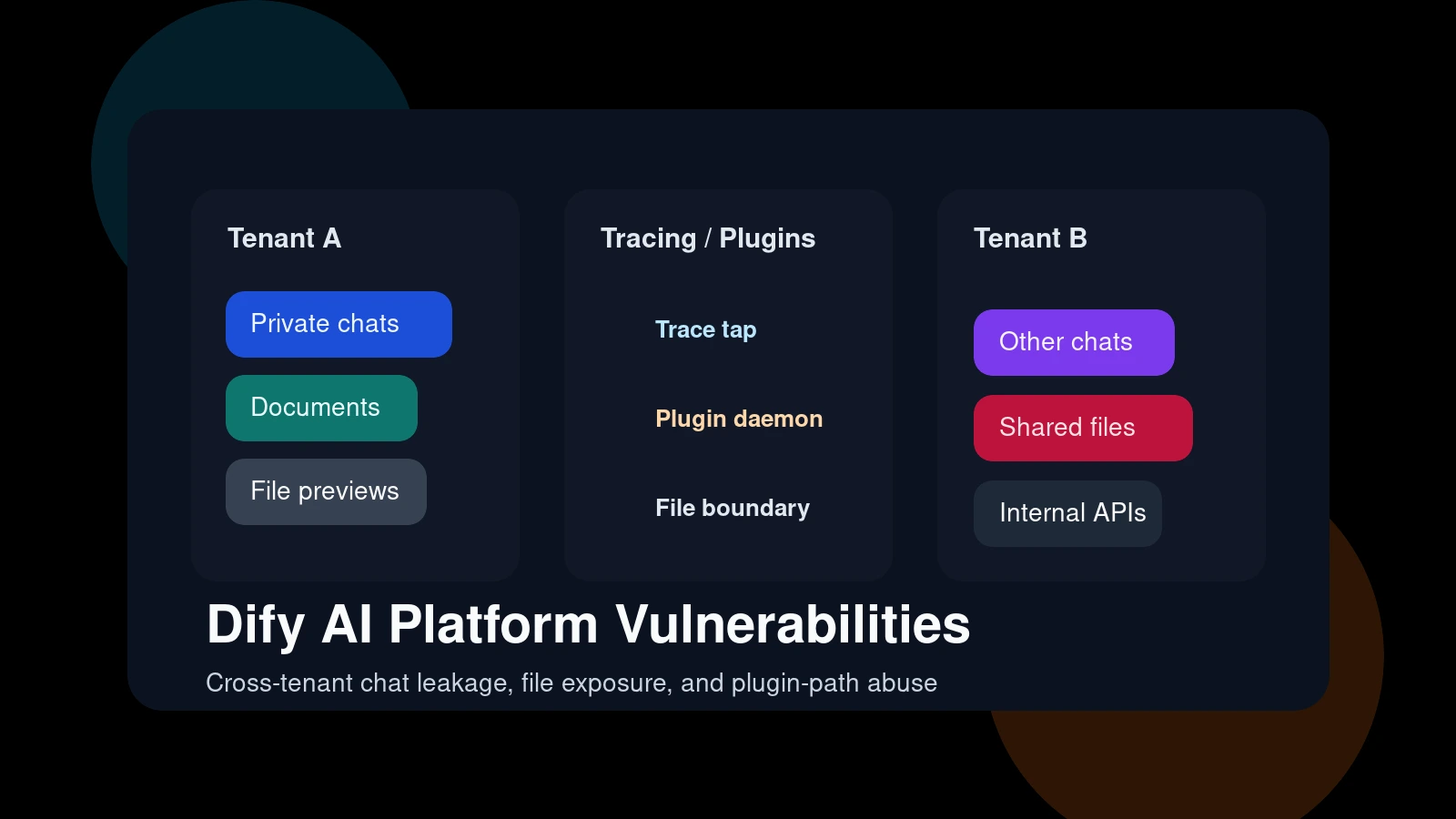
The Dify AI platform vulnerabilities became a live mainstream security story on June 23, 2026, when SecurityWeek took Zafran's technical findings and translated them into a broader warning for defenders. That publication date is the freshness gate for this post. The underlying research is supporting context. The public hook that makes this worth publishing now is yesterday's wider disclosure to the enterprise security audience.
That matters because these are not narrow lab bugs in a forgotten side project. Dify is an LLMOps platform used to build and operate AI applications at scale, and the newly disclosed DifyTap issues show how private chat histories, uploaded files, and internal service paths can become reachable across customer boundaries when multi-tenant trust checks break in the wrong places.
Key Stat: SecurityWeek says Dify powers more than 1 million applications across 50+ industries, which turns a platform bug into a downstream exposure problem for a large slice of the AI app ecosystem.
Why the Dify AI platform vulnerabilities matter now
There is a habit in AI security coverage that weakens the defender takeaway. People see new CVEs in an app builder, then treat the story as a routine patch note with a slightly futuristic label.
That is not the right read here. The Dify AI platform vulnerabilities matter because they land in exactly the components AI teams keep trusting by default:
- observability and tracing
- plugin execution layers
- file preview and retrieval paths
- shared tenant plumbing behind customer-facing apps
Those are not decorative features. They are the operational core of how many AI products now work. If the tracing plane can be hijacked, the plugin layer can reach internal paths, or the file layer can cross tenant boundaries, then your AI stack is not only answering prompts. It is quietly creating an exfiltration surface.
This is why the story fits alongside earlier Hexon themes such as Microsoft 365 Copilot data theft, ChatGPT lockdown mode, and AI agent security scoring. The repeated lesson is that the dangerous part of AI systems is often not the model alone. It is the surrounding glue that decides what the model can see, store, fetch, or forward.
Key Takeaway: DifyTap is not mainly a story about one open source AI tool. It is a story about how AI application platforms keep collapsing the boundary between convenience features and security-critical control planes.
How DifyTap turns normal platform features into an exfiltration path
According to Zafran's DifyTap research, four flaws made it possible to abuse Dify's multi-tenant architecture in several directions at once.
The public write-up highlighted two critical issues and two high-severity issues:
- CVE-2026-41947 in tracing configuration
- CVE-2026-41948 in the plugin daemon
- CVE-2026-41949 in document preview access checks
- CVE-2026-41950 in file access controls within a tenant
The technical details differ, but the strategic pattern is consistent. Dify allowed attackers to interact with platform features that should have been tightly scoped to one app, one tenant, or one user context, and those checks were either incomplete or missing.
Tracing became a wiretap
The tracing flaw is the cleanest example of why AI tooling creates unusual exposure. Tracing is supposed to help operators monitor prompts, responses, and app behavior. That makes it useful. It also makes it sensitive.
If an attacker can configure tracing for an application they should not control, they do not need to steal a database first. They can simply turn the observability layer into a persistent exfiltration channel for prompts and model responses. In an enterprise environment, that can mean customer conversations, internal workflow text, knowledge-retrieval output, or agent decision traces.
This is not a classic data breach pattern from an old web app. It is specific to modern AI operations, where logging and observability often capture the very content companies most want to protect.
The plugin daemon widened the blast radius
The plugin daemon issue matters for a second reason. AI platforms increasingly depend on plugins, connectors, tools, and background services to give applications real-world utility.
That same utility creates risk when request boundaries are not strict enough. SecurityWeek's summary of Zafran's findings says the plugin daemon flaw could let attackers reach arbitrary API endpoints through GET and POST primitives, fetch other tenants' plugin assets, and interfere with adjacent environments. That is a reminder that tool execution layers can become internal pivots, not just feature enablers.
Common Mistake: Treating plugin infrastructure like a product-extension layer instead of a privileged internal service boundary. In AI systems, those are often the same thing.
File handling kept the trust surface open
The remaining flaws involve document preview and file retrieval. Those sound less dramatic than a critical daemon bug, but they matter because AI application builders are document-heavy by design.
Teams upload playbooks, policies, contracts, support docs, PDFs, and internal knowledge files into these systems all the time. If preview or retrieval checks fail, a tenant-isolated assistant becomes a content leakage engine. That is especially concerning in environments where employees assume the platform boundary already guarantees separation.
Why multi-tenant AI builders keep recreating old shared-trust failures
The interesting part of this story is not that Dify had four bugs. Any complex product can ship bugs. The interesting part is where those bugs lived.
They lived in the exact areas where AI platform teams are under pressure to move fast:
- telemetry
- plugins and connectors
- retrieval and file operations
- low-code workflow convenience
This pressure creates a familiar failure mode. The product surface expands faster than the trust model matures.
That is why the Dify story feels bigger than the patch itself. It echoes the same hidden-control-plane problem we saw in Mastra's AI supply chain incident, even though the mechanism is different. In Mastra, the risk came through maintainer control of a dependency chain. In Dify, the risk comes through platform internals that decide who can observe, fetch, and traverse sensitive data paths.
It also resembles the problem in safe AI use at work, where the hardest security question is often not "should we allow AI?" but "what exactly can this AI-adjacent system touch once it is approved?"
In other words, the AI model gets most of the attention, while the platform around it quietly becomes the real attack surface.
Pro Tip: When reviewing an AI platform, map the trust boundaries around logs, plugins, file previews, and internal service calls before you spend hours debating prompt quality or model choice.
What teams running Dify should do in the next 24 hours
This is a good case for a focused response rather than a vague AI security review.
1. Verify the exact Dify version in production
SecurityWeek says Dify 1.14.2 includes fixes for the disclosed issues. That does not mean your environment is already safe.
Many teams running fast-moving AI platforms lose track of whether they are using:
- a current upstream release
- a pinned self-hosted image
- a modified internal deployment
- a managed environment with delayed rollout timing
Do not assume the platform has been patched just because the vendor has published a fixed release.
2. Review who can access the console
Zafran's write-up indicates some abuse paths start from a console user position. That matters because console access is often handed out too broadly in experimentation-heavy AI programs.
Review:
- which users can sign into the console
- which roles can configure tracing
- which users can install or manage plugins
- whether stale developer and contractor accounts still exist
This is basic identity hygiene, but it matters more in AI platforms because a "builder" account can touch data flow, observability, and tool execution at the same time.
3. Tighten external exposure for public apps
The research notes that publicly accessible applications create a path for attackers to interact with platform features more easily. If your Dify apps are internet-facing, treat them as active attack surface, not as harmless chatbot wrappers.
That means checking:
- whether public app publishing is actually required
- whether app endpoints sit behind stronger access controls
- whether unused or experimental apps are still reachable
- whether tenant separation assumptions have been validated in practice
4. Revisit tracing, plugin, and file permissions as separate security domains
One weakness in modern AI operations is bundling too many capabilities into one mental category called "the platform." DifyTap shows why that is sloppy.
Tracing, plugin execution, and file access should each be reviewed as their own security domain with their own abuse cases. If one control plane is compromised, it should not automatically create visibility into everything else.
5. Hunt for evidence of unusual cross-app or cross-tenant activity
Even if there is no public evidence of mass exploitation yet, this is still worth retrospective review. Look for signs such as:
- tracing configurations changed unexpectedly
- unusual plugin daemon requests
- access to documents that do not match normal user behavior
- public apps receiving odd enumeration patterns
- internal API paths being reached through app-layer features
The point is not to panic. The point is to stop treating the AI platform as a black box.
What the Dify story means for the wider AI security stack
The broader lesson is uncomfortable but useful. AI platforms are now mature enough to carry real business data, but many organizations still evaluate them like developer tools in a lab.
That gap shows up everywhere:
- experimentation culture expands access faster than governance
- observability captures sensitive content by design
- connectors turn product features into internal reach
- multi-tenant assumptions are trusted without deep testing
- document workflows blur the line between content and privileged data
This is one reason recent Hexon coverage keeps returning to AI control planes rather than AI hype. The systems that make AI helpful also make it operationally dangerous when boundaries fail.
If you only ask whether a model can hallucinate, you miss the more immediate risk. A flawed AI platform can expose real tenant data even when the model behaves exactly as intended.
That is why this story deserves attention from security leaders who do not even use Dify. The architecture pattern is spreading across copilots, agent builders, retrieval systems, and internal AI workflow tools. Different product names, same mistake: too much trust in the middleware around the model.
Key Stat: The search results around this disclosure were crowded within a day by SecurityWeek, Dark Reading, SC Media, The Hacker News, and multiple follow-on outlets. That tells you the market recognized DifyTap as more than a niche bug report. It hit a wider nerve about shared AI infrastructure.
Final takeaway
The Dify AI platform vulnerabilities clear the freshness bar because the main hook is SecurityWeek's June 23, 2026 publication, which falls within the allowed yesterday fallback window. Zafran's research and Dify's fixed release are supporting sources, not the freshness gate.
For defenders, the practical lesson is straightforward. If an AI application platform can log conversations, preview files, run plugins, and expose public apps, then it deserves the same threat-model scrutiny as any other multi-tenant data system. DifyTap is a reminder that in AI security, the real risk often lives in the control plane around the model, not only in the model itself.