The TrojPix attack became a same-day security story on July 6, 2026, when The Hacker News highlighted new research showing that an air-gapped system can still leak data through the electromagnetic emissions of an ordinary video cable. That matters because many teams still treat "not connected to the network" as if it were the end of the conversation.
It is not. TrojPix does not magically jump an air gap by itself, and that distinction matters. But once malware already lands on a sensitive machine, the research says a nearby receiver may be able to recover data by reading radio leakage created through tiny on-screen pixel changes that a human user would never notice.
Key Stat: The USENIX Security 2026 paper reports up to 8.1 Mbps peak throughput and a maximum range of 208 meters, measured separately, across nine monitor brands and fifteen commercial video cables.
Why the TrojPix attack matters now
Freshness matters here. The publishable hook is The Hacker News report published on July 6, 2026, supported by the newly available USENIX research page for TrojPix. Older TEMPEST history and earlier covert-channel papers are context, not the freshness gate.
If you are responsible for sensitive engineering labs, industrial environments, government systems, or research workstations, the story is relevant for a simple reason: air-gapped does not mean malware-proof, and malware-proof does not mean emission-proof. TrojPix compresses those assumptions into one uncomfortable lesson.
Hexon has covered adjacent trust failures before, from the Itron critical infrastructure breach to practical defenses like endpoint hygiene for small businesses, guest Wi-Fi segmentation, and DNS filtering. TrojPix belongs in that conversation because it reminds defenders that isolation is not a single control. It is a stack of controls, and the stack fails if the endpoint itself is already compromised.
Key Takeaway: TrojPix does not kill the idea of air-gapped security. It kills the lazy version of it.
How TrojPix turns a video cable into a leak path
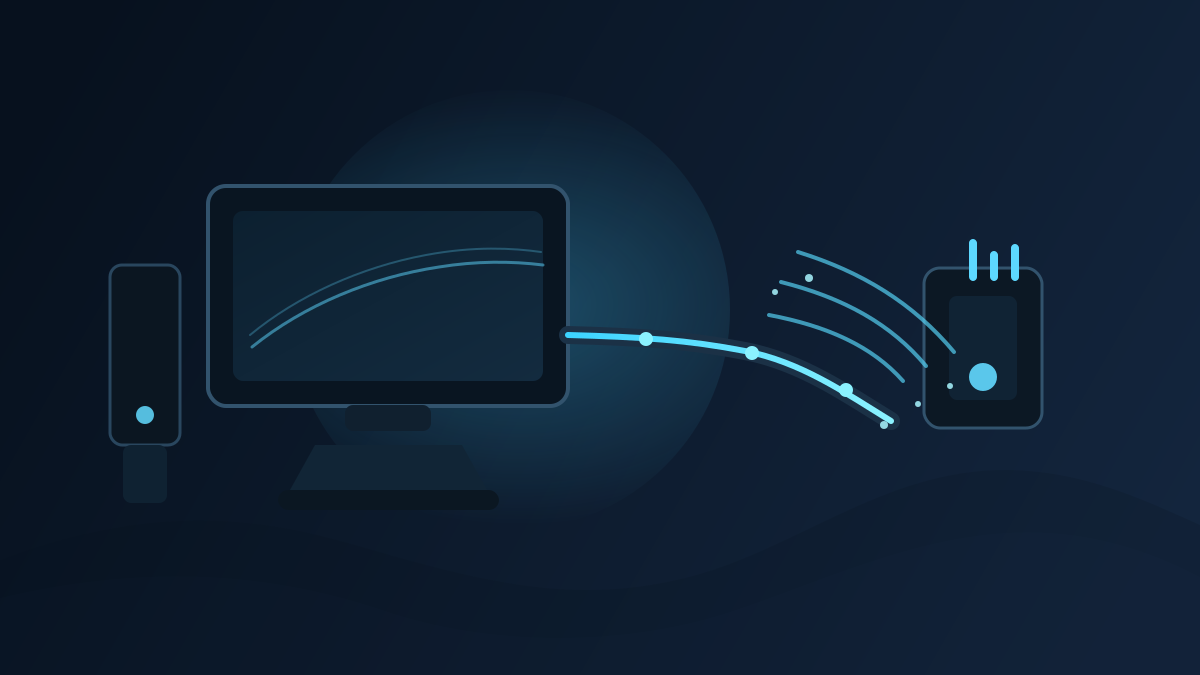
According to the USENIX abstract, TrojPix uses imperceptible pixel modulation to create controllable electromagnetic emissions on digital video cables. In plain English, malware changes pixels on the display in ways the user cannot see, but the cable still carries those signal changes physically.
Those signal changes can radiate faint electromagnetic energy. A nearby receiver can then sample and decode that leakage to reconstruct the transmitted data. That is why the cable matters. The monitor is part of the visible experience, but the cable is part of the physical signal path that attackers may be able to abuse.
The researchers describe two operating modes that make the technique more practical:
- Fake screen-off mode, where the display appears dark while transmission continues
- Foreground embedding mode, where the leakage is hidden inside normal-looking content already on screen
- No special privileges or hardware modifications, meaning user-level malware may be enough to trigger the effect
That last point is important. TrojPix is not framed as a root-only attack that requires custom implants soldered into the machine. Its value as research comes from how much it can do with ordinary hardware conditions once code is already running on the target.
Fake screen-off mode
One of the most striking parts of the paper is the idea that a machine can appear effectively idle while still transmitting. If the user or nearby operator thinks the monitor is dark, they may assume little or nothing interesting is happening on the display path.
That assumption breaks here. A dark-looking screen can still carry carefully chosen signal patterns that the eye does not interpret as meaningful content, while a receiver interprets them as data.
Foreground embedding mode
The second mode is arguably more realistic in day-to-day operations. Instead of making the screen look blank, the transmission is blended into ordinary foreground content so the workstation continues to look normal during use.
That matters because stealth is often more valuable than raw cleverness. A covert channel that only works in obviously suspicious conditions is less operationally useful than one that hides inside routine work.
Why air gaps fail when the endpoint is already compromised
The most useful way to read the TrojPix attack is not as science-fiction panic. It is as a reminder that air gaps are boundary controls, not magic spells. They stop direct network reachability, but they do not erase every possible path for data movement.
That may sound obvious, yet security teams still simplify air-gapped discussions too aggressively. If a machine is isolated from the internet, people often start talking as if exfiltration is nearly impossible by default. In reality, the question changes from "is there a network route?" to "what side channels remain once malware gets in?"
That is where TrojPix becomes strategically useful. It tells you to revisit the full threat chain:
- How could malware land on the supposedly isolated system in the first place?
- What data on that system would be worth leaking?
- What physical, radio, or operator conditions would make leakage feasible?
- What would your team notice first: the intrusion, the exfiltration, or neither?
For many organizations, the real weakness is not the exotic exfiltration path. It is the quiet confidence that the machine is "safe enough" because it does not browse the internet directly.
Common Mistake: Treating air-gapped protection as a network architecture decision only. TrojPix is a reminder that the endpoint, the room, and the surrounding hardware all belong in the threat model too.
Where the real enterprise risk shows up
Not every company needs to lose sleep over video cable emissions. Most do not run high-value air-gapped workloads, and most attackers will still choose easier routes like phishing, remote access abuse, or cloud identity compromise.
But some environments should take this seriously right away:
- industrial control or operational technology workstations
- defense, research, or government labs handling sensitive material
- offline signing, engineering, or forensic systems
- executive or M&A rooms where highly sensitive files sit on isolated machines
In those cases, TrojPix changes the economics of what "good enough" looks like. A covert channel that can move far more than a password or a token starts to matter differently. The Hacker News notes that a 100 MB file could move in under two minutes at the reported peak throughput, which turns the scenario from novelty into an uncomfortable planning problem.
This also connects to older ideas captured in NIST's TEMPEST glossary and broader emission security thinking. The security community has known for decades that unintentional emanations can betray sensitive activity. What TrojPix adds is a more modern demonstration that commodity displays and cables can still become useful carriers under the right conditions.
The bigger lesson is organizational. If your isolation strategy assumes that exotic exfiltration is too hard to matter, you may underinvest in the earlier controls that actually decide whether such a technique can ever be used against you.
What defenders should do now
The right reaction is not to ban monitors or treat every dark screen like an incident. The right reaction is to tighten the chain that has to break before TrojPix becomes practical.
Start with the part you can control most easily: keep malware off the isolated machine. That means harder control over removable media, stricter software provenance, fewer ad hoc file transfers, stronger application allowlisting, and a real process for validating what enters the environment.
Then address the surrounding environment:
- reduce unnecessary physical proximity to sensitive systems
- review where monitors, cables, and nearby devices sit in the room
- separate highly sensitive workstations from casual shared spaces
- restrict unauthorized wireless receivers or rogue electronics near protected areas
For many teams, the immediate control gap is not EMSEC engineering. It is operational discipline. Machines that are described as isolated often still depend on hurried updates, borrowed USB devices, contractor laptops, or weak transfer procedures. That is the part attackers will test first.
For high-assurance environments
If you truly protect crown-jewel workloads, TrojPix is a signal to review your environment at a deeper level. The paper specifically recommends fiber-optic video links, shielding, and hardened rooms in cases where the data sensitivity justifies it.
That does not mean every organization needs TEMPEST-grade facilities. It does mean high-assurance teams should stop pretending that physical separation alone fully answers emanation risk. If your risk model includes state-level espionage or highly resourced adversaries, this belongs on the review list.
For everyone else
Most readers should translate TrojPix into a simpler operational checklist:
- treat isolated endpoints like premium assets, not forgotten appliances
- verify software sources before files reach sensitive machines
- use secure file-sharing practices and documented transfer workflows
- keep surrounding endpoints and user devices clean so the first foothold is harder to win
- build a response plan, because rare attacks still benefit from ordinary incident-response discipline
That may sound less dramatic than radio leakage from a video cable, but it is the practical core of the story. Most covert-channel research becomes dangerous only after ordinary security failures create the opening.
What TrojPix does not prove
This is the part worth saying plainly. TrojPix is important research, but it is still research. It does not prove that widespread in-the-wild campaigns are already stealing sensitive files from air-gapped networks through every office monitor.
It also does not remove the prerequisites:
- the target machine must already be compromised
- the attacker needs a viable receiving setup and favorable conditions
- the environment still has to allow the channel to operate long enough to matter
Those constraints are why the story should sharpen security thinking, not flatten it into hype. A mature response balances two facts at once: the attack is real enough to influence high-assurance design, and still niche enough that many teams face easier, more common risks first.
Pro Tip: If TrojPix makes your security plan sound fragile, the first fix is usually not a shielding budget. It is a sharper inventory of which machines are truly high sensitivity and which controls already govern what reaches them.
Final takeaway
The main hook source is The Hacker News, published July 6, 2026, and it is strong because it makes the freshness of the story clear while pointing to concrete new research. The accompanying USENIX material gives the story enough technical weight to be more than a headline.
For defenders, the enduring message is simple: air-gapped systems are safer because they remove easy paths, not because they remove every path. TrojPix shows how quickly "physically isolated" can become "physically signaling" once malware is already inside the boundary.
That is why the practical response starts earlier than fancy shielding. Tighten software trust, transfer discipline, physical access, room design, and endpoint hygiene first. Then, if you truly operate crown-jewel systems, ask the harder EMSEC questions before an attacker does.