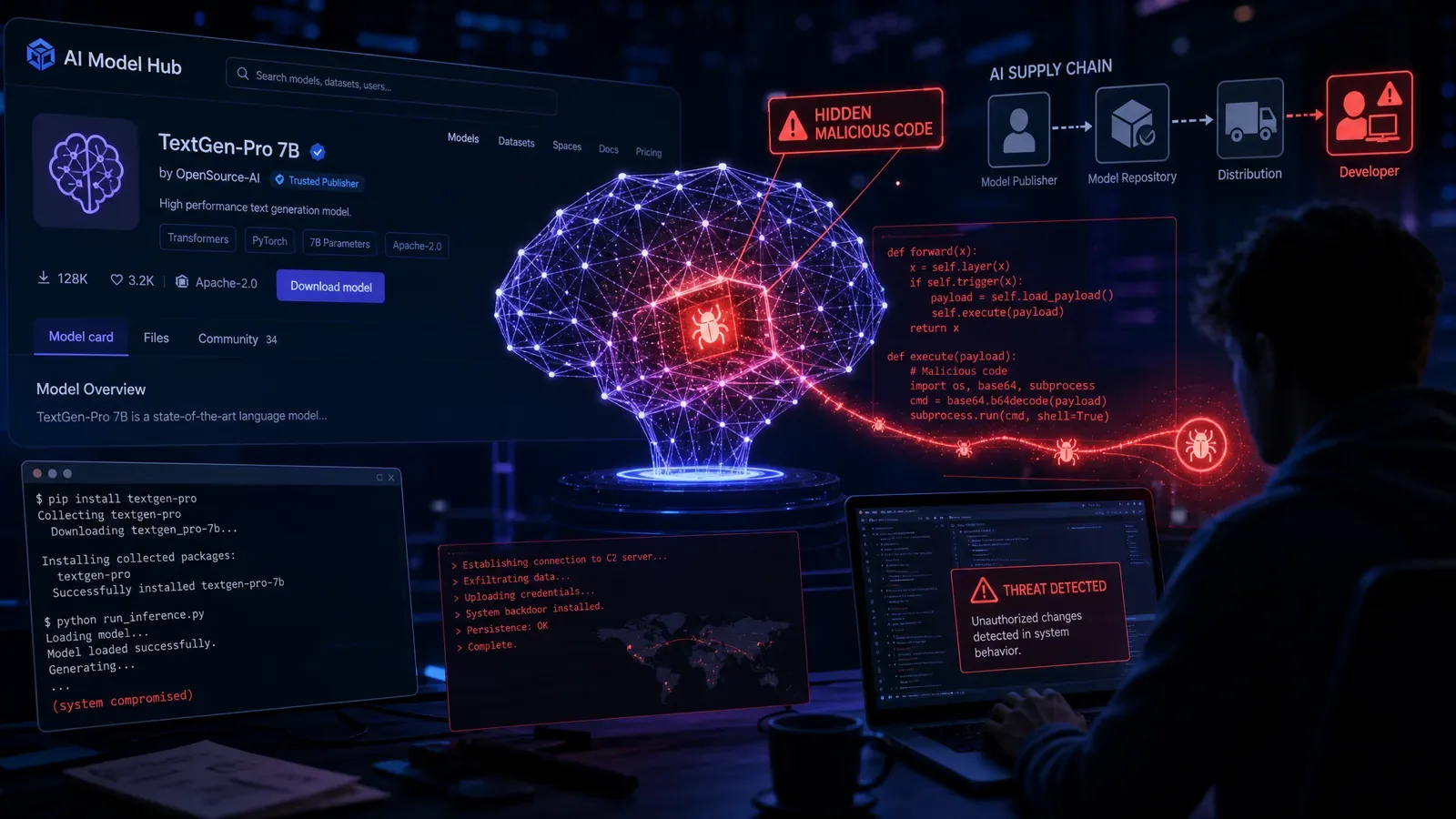
A fake OpenAI repository on Hugging Face reached the platform's #1 trending position and infected 244,000 developers with malware before anyone noticed. The malicious project impersonated OpenAI's legitimate Privacy Filter tool, copied its model card nearly verbatim, and shipped a hidden payload that stole browser credentials, cryptocurrency wallets, and SSH keys from Windows machines.
This is not a theoretical supply chain risk. This happened on May 7, 2026, on one of the most trusted AI platforms in the world. The attack exposes a dangerous blind spot in how developers consume open-source AI models and raises urgent questions about platform security, user trust, and the growing weaponization of AI infrastructure.
The Attack: How a Fake Repository Reached #1 Trending
The Setup
Hugging Face hosts over one million machine learning models and serves as the central repository for the global AI development community. Researchers, startups, and enterprise teams routinely download models, datasets, and code from the platform without deep security vetting. That implicit trust is exactly what this attack exploited.
The malicious repository, named Open-OSS/privacy-filter, typosquatted OpenAI's legitimate Privacy Filter release. It copied the model card almost word-for-word and included a file called loader.py that appeared to contain benign AI-related code. HiddenLayer researchers discovered the campaign on May 7, 2026, after noticing suspicious activity tied to the repository.
Key Stat: The repository accumulated 244,000 downloads and reached #1 on Hugging Face's trending list before the platform removed it. The vast majority of the 667 accounts that liked the repository appear to be auto-generated bots used to artificially inflate perceived legitimacy.
The Infection Chain
The loader.py script used a classic bait-and-switch technique. It presented fake AI-related code to appear harmless while executing a multi-stage payload in the background:
- Disable SSL verification to bypass security checks during download
- Decode a base64 URL pointing to an external malicious resource
- Fetch and execute a JSON payload containing a PowerShell command
- Download start.bat via the PowerShell command
- Escalate privileges, add exclusions to Microsoft Defender, and execute the final payload
The PowerShell command ran in an invisible window, ensuring victims remained unaware that their machine was being compromised.
Common Mistake: Many developers assume that code hosted on reputable platforms like Hugging Face has been vetted for security. This attack proves that popularity metrics - downloads, likes, trending status - are not security indicators and can be easily manipulated by threat actors.
The Payload: Sefirah Infostealer Targets Everything Valuable
The final payload is a Rust-based infostealer called Sefirah that targets a comprehensive list of sensitive data sources. The malware's scope demonstrates that this was not an opportunistic attack but a carefully engineered campaign designed to maximize value extraction from AI developers.
What Sefirah Steals
- Browser data from Chromium and Gecko-based browsers: cookies, saved passwords, encryption keys, browsing history, session tokens
- Discord tokens and local databases with master keys
- Cryptocurrency wallets and wallet browser extensions
- SSH, FTP, and VPN credentials including FileZilla configuration files
- Sensitive local files and wallet seeds or keys
- System information and multi-monitor screenshots
The stolen data is compressed and exfiltrated to a command-and-control server at recargapopular[.]com.
Anti-Analysis Features
Sefirah includes extensive anti-analysis capabilities designed to evade detection by security researchers and automated analysis systems:
- Virtual machine detection
- Sandbox environment checks
- Debugger identification
- Analysis tool detection
These features suggest the malware was developed by experienced threat actors with knowledge of modern security research workflows.
Key Takeaway: The combination of Rust-based compilation, multi-stage delivery, and comprehensive anti-analysis features indicates this was a professional operation, not amateur malware. The threat actors understood both AI developer behavior and modern endpoint security tools.
%22%2F%3E%0A%20%20%3Ccircle%20cx%3D%221270%22%20cy%3D%22180%22%20r%3D%22210%22%20fill%3D%22rgba(123%2C%20215%2C%20255%2C%200.18)%22%2F%3E%0A%20%20%3Ccircle%20cx%3D%22310%22%20cy%3D%22710%22%20r%3D%22250%22%20fill%3D%22rgba(52%2C%20211%2C%20153%2C%200.10)%22%2F%3E%0A%20%20%3Cpath%20d%3D%22M160%20708C340%20574%20498%20531%20653%20566C828%20605%20941%20504%201086%20418C1191%20355%201308%20317%201440%20332%22%20stroke%3D%22%237bd7ff%22%20stroke-width%3D%2210%22%20stroke-linecap%3D%22round%22%20opacity%3D%220.85%22%2F%3E%0A%20%20%3Cpath%20d%3D%22M160%20640H1440%22%20stroke%3D%22rgba(255%2C255%2C255%2C0.08)%22%20stroke-width%3D%222%22%2F%3E%0A%20%20%3Cpath%20d%3D%22M160%20298H1440%22%20stroke%3D%22rgba(255%2C255%2C255%2C0.08)%22%20stroke-width%3D%222%22%2F%3E%0A%20%20%3Crect%20x%3D%22160%22%20y%3D%22142%22%20width%3D%22174%22%20height%3D%2236%22%20rx%3D%2218%22%20fill%3D%22rgba(123%2C%20215%2C%20255%2C%200.18)%22%20stroke%3D%22%237bd7ff%22%2F%3E%0A%20%20%3Ctext%20x%3D%22247%22%20y%3D%22166%22%20text-anchor%3D%22middle%22%20fill%3D%22%23D9F4FF%22%20font-size%3D%2218%22%20font-family%3D%22Arial%2C%20Helvetica%2C%20sans-serif%22%20letter-spacing%3D%222%22%3EAI%20SECURITY%3C%2Ftext%3E%0A%20%20%3Ctext%20x%3D%22160%22%20y%3D%22392%22%20fill%3D%22%23F7FBFF%22%20font-size%3D%2266%22%20font-weight%3D%22700%22%20font-family%3D%22Arial%2C%20Helvetica%2C%20sans-serif%22%3EThe%20Bigger%20Picture%3A%20AI%3C%2Ftext%3E%0A%20%20%3Ctext%20x%3D%22160%22%20y%3D%22470%22%20fill%3D%22%23F7FBFF%22%20font-size%3D%2266%22%20font-weight%3D%22700%22%20font-family%3D%22Arial%2C%20Helvetica%2C%20sans-serif%22%3EPlatforms%20as%20Supply%20Chain%3C%2Ftext%3E%0A%20%20%3Ctext%20x%3D%22160%22%20y%3D%22554%22%20fill%3D%22%23A8B8C8%22%20font-size%3D%2228%22%20font-family%3D%22Arial%2C%20Helvetica%2C%20sans-serif%22%3EHugging%20Face%20Malware%20Supply%20Chain%20Attack%3A%3C%2Ftext%3E%0A%20%20%3Crect%20x%3D%221080%22%20y%3D%22420%22%20width%3D%22274%22%20height%3D%22182%22%20rx%3D%2222%22%20fill%3D%22%230E2231%22%20stroke%3D%22rgba(255%2C255%2C255%2C0.10)%22%2F%3E%0A%20%20%3Crect%20x%3D%221120%22%20y%3D%22458%22%20width%3D%22112%22%20height%3D%2218%22%20rx%3D%229%22%20fill%3D%22%237bd7ff%22%20opacity%3D%220.9%22%2F%3E%0A%20%20%3Crect%20x%3D%221120%22%20y%3D%22498%22%20width%3D%22180%22%20height%3D%2212%22%20rx%3D%226%22%20fill%3D%22rgba(255%2C255%2C255%2C0.2)%22%2F%3E%0A%20%20%3Crect%20x%3D%221120%22%20y%3D%22526%22%20width%3D%22146%22%20height%3D%2212%22%20rx%3D%226%22%20fill%3D%22rgba(255%2C255%2C255%2C0.14)%22%2F%3E%0A%20%20%3Crect%20x%3D%221120%22%20y%3D%22554%22%20width%3D%2288%22%20height%3D%2212%22%20rx%3D%226%22%20fill%3D%22rgba(255%2C255%2C255%2C0.12)%22%2F%3E%0A%20%20%3Ccircle%20cx%3D%221340%22%20cy%3D%22522%22%20r%3D%2244%22%20fill%3D%22rgba(123%2C%20215%2C%20255%2C%200.18)%22%20stroke%3D%22%237bd7ff%22%2F%3E%0A%20%20%3Cpath%20d%3D%22M1322%20522L1336%20536L1360%20506%22%20stroke%3D%22%237bd7ff%22%20stroke-width%3D%228%22%20stroke-linecap%3D%22round%22%20stroke-linejoin%3D%22round%22%2F%3E%0A%20%20%3Ctext%20x%3D%22160%22%20y%3D%22748%22%20fill%3D%22%237BD7FF%22%20font-size%3D%2222%22%20font-family%3D%22Arial%2C%20Helvetica%2C%20sans-serif%22%20letter-spacing%3D%223%22%3EHEXON%20%2F%2F%20SUPPORTING%20VISUAL%3C%2Ftext%3E%0A%3C%2Fsvg%3E)
The Bigger Picture: AI Platforms as Supply Chain Attack Vectors
From Traditional Software to AI Infrastructure
Supply chain attacks have historically targeted package managers like npm, PyPI, and RubyGems. The Hugging Face incident represents a significant evolution: threat actors are now targeting the AI-specific infrastructure that developers trust to build the next generation of applications.
This attack is part of a broader pattern. In March 2026, the LiteLLM package on PyPI was compromised, potentially exposing 500,000 credentials including API keys for Meta, OpenAI, and Anthropic. In April 2026, Acronis TRU identified 575 malicious skills published across 13 developer accounts on ClawHub, the public registry for OpenClaw's AI agent skills.
Key Stat: Protect AI, which partnered with Hugging Face to scan the platform's model library, has examined over four million models and identified approximately 352,000 unsafe or suspicious issues across 51,700 models.
Why AI Repositories Are Prime Targets
AI model repositories present unique attack opportunities that traditional software package managers do not:
- Large file sizes make manual inspection impractical
- Complex serialization formats like Python's pickle can hide arbitrary code execution
- Implicit trust from developers who assume platform vetting
- High-value targets including API keys, model weights, and proprietary training data
- Autonomous execution where AI agents may run downloaded code without human review
The attack technique known as nullifAI exploits Python's pickle serialization format, the standard method for packaging machine learning models. Attackers embed malicious Python code at the start of the serialized object, which executes immediately when the model is loaded.
Pro Tip: Never load pickle files from untrusted sources. Use safer alternatives like SafeTensors for model weights, and always inspect code repositories before executing scripts from AI platforms.
The Trust Problem: When Popularity Becomes a Weapon
Artificial Inflation and Social Proof
The Hugging Face attack leveraged social proof as a weapon. By using auto-generated accounts to like the repository and artificially inflate download counts, the threat actors created the appearance of legitimacy. Developers naturally gravitate toward popular, well-liked repositories, and this behavioral pattern was systematically exploited.
HiddenLayer researchers noted that the 667 accounts that liked the malicious repository appear to be auto-generated. The 244,000 download count was likely artificially inflated as well. This manipulation of platform metrics represents a new frontier in social engineering at scale.
Platform Responsibility vs. User Vigilance
Hugging Face has been aware of malicious models on its platform since at least 2024, when security firms JFrog and ReversingLabs independently identified models containing hidden backdoors. The platform has partnered with Protect AI for scanning and has removed malicious content when identified.
However, the May 2026 incident demonstrates that reactive removal is insufficient. A repository reached #1 trending and accumulated a quarter-million downloads before researchers flagged it. For platforms hosting millions of models, the challenge of proactive detection at scale is immense.
Key Takeaway: Platform security teams cannot catch every malicious upload in real-time. Developers must treat AI model repositories with the same skepticism they apply to random GitHub repositories or email attachments. Popularity metrics are not security guarantees.
Immediate Defenses: How to Protect Your Organization
For Individual Developers
If you downloaded anything from the Open-OSS/privacy-filter repository or similar suspicious projects, take these steps immediately:
- Reimage the affected machine - Do not attempt to clean the infection manually
- Rotate all stored credentials - Passwords, API keys, tokens, and certificates
- Replace cryptocurrency wallets and seed phrases
- Invalidate browser sessions and Discord tokens
- Review SSH and VPN configurations for unauthorized access
For Security Teams
Organizations using AI models from public repositories should implement these controls:
- Vet all downloaded models before loading them into production environments
- Use sandboxed environments for initial model inspection and testing
- Scan pickle files with tools that detect embedded code execution
- Prefer SafeTensors format over pickle when available
- Implement code review for any scripts or loaders downloaded with models
- Monitor for suspicious network connections from development workstations
- Restrict AI model downloads to approved repositories with security validation
For Platform Operators
AI repository platforms must strengthen their security posture:
- Proactive scanning of all uploaded models for embedded malicious code
- Behavioral analysis of account activity to detect artificial inflation
- Reputation systems that weight verified accounts more heavily than new accounts
- Sandboxed execution environments for testing uploaded code
- Clear security warnings when models use serialization formats capable of arbitrary code execution
Pro Tip: Consider implementing an internal AI model registry that mirrors approved external repositories. This creates a controlled checkpoint where security teams can review models before developers access them, without blocking legitimate AI development workflows.
%22%2F%3E%0A%20%20%3Ccircle%20cx%3D%221270%22%20cy%3D%22180%22%20r%3D%22210%22%20fill%3D%22rgba(167%2C%20139%2C%20250%2C%200.18)%22%2F%3E%0A%20%20%3Ccircle%20cx%3D%22310%22%20cy%3D%22710%22%20r%3D%22250%22%20fill%3D%22rgba(52%2C%20211%2C%20153%2C%200.10)%22%2F%3E%0A%20%20%3Cpath%20d%3D%22M160%20708C340%20574%20498%20531%20653%20566C828%20605%20941%20504%201086%20418C1191%20355%201308%20317%201440%20332%22%20stroke%3D%22%23a78bfa%22%20stroke-width%3D%2210%22%20stroke-linecap%3D%22round%22%20opacity%3D%220.85%22%2F%3E%0A%20%20%3Cpath%20d%3D%22M160%20640H1440%22%20stroke%3D%22rgba(255%2C255%2C255%2C0.08)%22%20stroke-width%3D%222%22%2F%3E%0A%20%20%3Cpath%20d%3D%22M160%20298H1440%22%20stroke%3D%22rgba(255%2C255%2C255%2C0.08)%22%20stroke-width%3D%222%22%2F%3E%0A%20%20%3Crect%20x%3D%22160%22%20y%3D%22142%22%20width%3D%22174%22%20height%3D%2236%22%20rx%3D%2218%22%20fill%3D%22rgba(167%2C%20139%2C%20250%2C%200.18)%22%20stroke%3D%22%23a78bfa%22%2F%3E%0A%20%20%3Ctext%20x%3D%22247%22%20y%3D%22166%22%20text-anchor%3D%22middle%22%20fill%3D%22%23D9F4FF%22%20font-size%3D%2218%22%20font-family%3D%22Arial%2C%20Helvetica%2C%20sans-serif%22%20letter-spacing%3D%222%22%3EAI%20SECURITY%3C%2Ftext%3E%0A%20%20%3Ctext%20x%3D%22160%22%20y%3D%22392%22%20fill%3D%22%23F7FBFF%22%20font-size%3D%2266%22%20font-weight%3D%22700%22%20font-family%3D%22Arial%2C%20Helvetica%2C%20sans-serif%22%3EThe%20Future%3A%20AI%20Supply%20Chain%3C%2Ftext%3E%0A%20%20%3Ctext%20x%3D%22160%22%20y%3D%22470%22%20fill%3D%22%23F7FBFF%22%20font-size%3D%2266%22%20font-weight%3D%22700%22%20font-family%3D%22Arial%2C%20Helvetica%2C%20sans-serif%22%3ESecurity%20in%202026%20and%20Beyond%3C%2Ftext%3E%0A%20%20%3Ctext%20x%3D%22160%22%20y%3D%22554%22%20fill%3D%22%23A8B8C8%22%20font-size%3D%2228%22%20font-family%3D%22Arial%2C%20Helvetica%2C%20sans-serif%22%3EHugging%20Face%20Malware%20Supply%20Chain%20Attack%3A%3C%2Ftext%3E%0A%20%20%3Crect%20x%3D%221080%22%20y%3D%22420%22%20width%3D%22274%22%20height%3D%22182%22%20rx%3D%2222%22%20fill%3D%22%230E2231%22%20stroke%3D%22rgba(255%2C255%2C255%2C0.10)%22%2F%3E%0A%20%20%3Crect%20x%3D%221120%22%20y%3D%22458%22%20width%3D%22112%22%20height%3D%2218%22%20rx%3D%229%22%20fill%3D%22%23a78bfa%22%20opacity%3D%220.9%22%2F%3E%0A%20%20%3Crect%20x%3D%221120%22%20y%3D%22498%22%20width%3D%22180%22%20height%3D%2212%22%20rx%3D%226%22%20fill%3D%22rgba(255%2C255%2C255%2C0.2)%22%2F%3E%0A%20%20%3Crect%20x%3D%221120%22%20y%3D%22526%22%20width%3D%22146%22%20height%3D%2212%22%20rx%3D%226%22%20fill%3D%22rgba(255%2C255%2C255%2C0.14)%22%2F%3E%0A%20%20%3Crect%20x%3D%221120%22%20y%3D%22554%22%20width%3D%2288%22%20height%3D%2212%22%20rx%3D%226%22%20fill%3D%22rgba(255%2C255%2C255%2C0.12)%22%2F%3E%0A%20%20%3Ccircle%20cx%3D%221340%22%20cy%3D%22522%22%20r%3D%2244%22%20fill%3D%22rgba(167%2C%20139%2C%20250%2C%200.18)%22%20stroke%3D%22%23a78bfa%22%2F%3E%0A%20%20%3Cpath%20d%3D%22M1322%20522L1336%20536L1360%20506%22%20stroke%3D%22%23a78bfa%22%20stroke-width%3D%228%22%20stroke-linecap%3D%22round%22%20stroke-linejoin%3D%22round%22%2F%3E%0A%20%20%3Ctext%20x%3D%22160%22%20y%3D%22748%22%20fill%3D%22%237BD7FF%22%20font-size%3D%2222%22%20font-family%3D%22Arial%2C%20Helvetica%2C%20sans-serif%22%20letter-spacing%3D%223%22%3EHEXON%20%2F%2F%20SUPPORTING%20VISUAL%3C%2Ftext%3E%0A%3C%2Fsvg%3E)
The Future: AI Supply Chain Security in 2026 and Beyond
Escalating Threat Landscape
The Hugging Face incident is not an isolated event. It represents the convergence of several trends that will define AI security in 2026:
- AI infrastructure maturation creating high-value targets
- Developer trust in platforms being systematically exploited
- Sophisticated threat actors adopting AI-specific attack vectors
- Autonomous AI agents executing downloaded code without human oversight
- Supply chain complexity making manual security review impractical
The Next Web reported on May 9, 2026, that both Hugging Face and ClawHub have been systematically compromised with hundreds of malicious entries. The attacks are different in technique but identical in logic: both exploit the implicit trust developers place in shared repositories.
The Need for AI-Native Security
Traditional software supply chain security tools were not designed for AI model repositories. New approaches are needed that understand:
- Model serialization formats and their inherent risks
- AI-specific attack patterns like prompt injection and model poisoning
- Autonomous agent behavior and the risks of automated code execution
- High-value AI assets including training data, model weights, and inference endpoints
Security teams must evolve their supply chain security programs to address AI-specific risks. The tools and processes that protect npm and PyPI dependencies are necessary but not sufficient for AI model security.
Key Stat: JFrog found more than 100 models on Hugging Face capable of arbitrary code execution using the nullifAI technique. The problem has not been contained - it has scaled.
Conclusion: Trust But Verify in the AI Era
The Hugging Face malware supply chain attack is a wake-up call for the AI development community. A fake repository reached #1 trending on one of the world's most trusted AI platforms and infected a quarter-million developers with professional-grade infostealer malware. The attack was sophisticated, well-engineered, and successful because it exploited the very trust that makes open-source AI ecosystems possible.
For developers, the lesson is clear: treat AI model repositories with the same skepticism you apply to any external code source. Popularity metrics can be manipulated. Trending status is not a security endorsement. And a copied model card does not mean the code inside is legitimate.
For organizations, the incident demands immediate action. Review your AI supply chain security controls. Implement vetting processes for downloaded models. Educate developers about AI-specific attack vectors. And recognize that the infrastructure built to accelerate AI development is now a primary target for sophisticated threat actors.
The AI revolution depends on open collaboration and shared resources. But that collaboration cannot come at the cost of security. The Sefirah infostealer campaign proves that when trust is exploited at scale, the consequences are measured in stolen credentials, emptied wallets, and compromised systems.
The models you download today could be the malware that steals your data tomorrow. Verify before you trust.
Stay ahead of AI supply chain threats. Subscribe to the Hexon.bot newsletter for weekly cybersecurity insights.