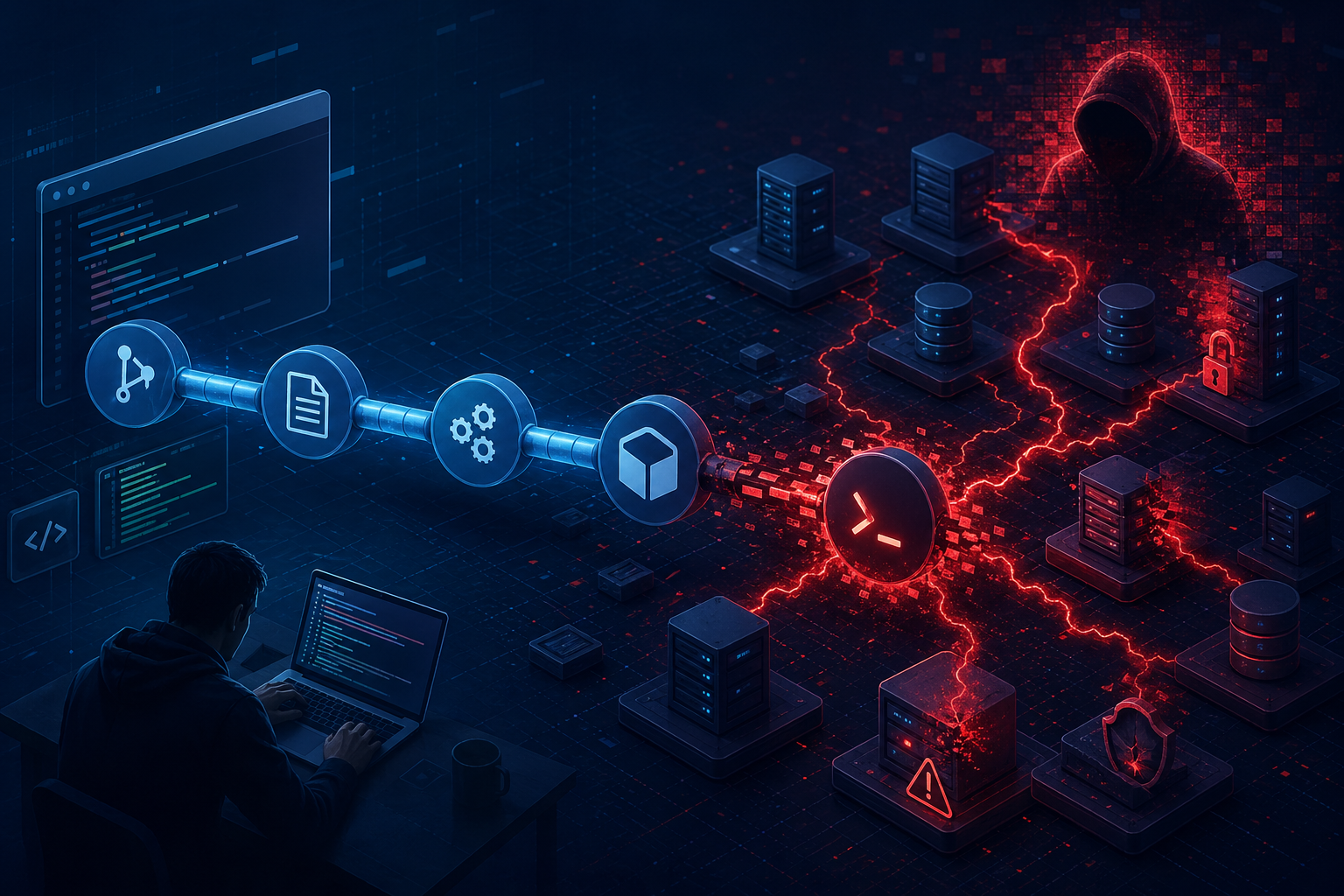
One git push command. That's all it took.
On March 4, 2026, security researchers at Wiz discovered something that should make every developer, security engineer, and CISO pause: a critical vulnerability in GitHub's internal infrastructure that allowed any authenticated user to achieve remote code execution on GitHub's backend servers using nothing more than a standard git client and a carefully crafted push option.
The flaw, tracked as CVE-2026-3854 (CVSS 8.7), wasn't just another bug in a web application. It was a fundamental weakness in how GitHub processes the most routine operation in software development - pushing code. And it exposed millions of repositories to potential cross-tenant access.
Here's the part that should keep you awake at night: 88% of GitHub Enterprise Server instances remain vulnerable at the time of disclosure. While GitHub.com was patched within two hours, countless enterprise installations are still running exposed versions.
How a Single Git Push Became a Weapon
The Architecture Problem
When you run git push against GitHub, your request flows through multiple internal services. Each service is written in a different programming language, and they communicate using an internal protocol that passes metadata about your push - repository type, environment settings, security policies.
The vulnerability existed in how user-supplied git push options were incorporated into this internal metadata. Push options are a legitimate git feature that lets clients send key-value strings to the server during a push. But GitHub's internal protocol used a semicolon as a delimiter - and that semicolon could also appear in user input.
This seemingly minor oversight created a command injection vector.
The Exploit Chain
Wiz researchers demonstrated that by chaining several injected values together, an attacker could:
- Inject a non-production rails_env value to bypass the sandbox
- Inject custom_hooks_dir to redirect the hook directory
- Inject repo_pre_receive_hooks with a crafted hook entry that triggers path traversal
- Execute arbitrary commands as the git user on the server
📊 Key Stat: According to Wiz, the entire exploit chain is "remarkably easy" to execute. The researchers noted: "A single git push command was enough to exploit a flaw in GitHub's internal protocol and achieve code execution on backend infrastructure."
The Cross-Tenant Nightmare
On GitHub.com, the implications were staggering. Because of GitHub's multi-tenant architecture and shared backend infrastructure, obtaining code execution on a shared storage node meant potential access to millions of public and private repositories belonging to other users and organizations.
GitHub's CISO, Alexis Wales, confirmed: "By chaining several injected values together, the researchers demonstrated that an attacker could override the environment the push was processed in, bypass sandboxing protections that normally constrain hook execution, and ultimately execute arbitrary commands on the server."
For GitHub Enterprise Server, the impact was even more severe: full server compromise, including access to all hosted repositories and internal secrets.
AI-Assisted Discovery: A New Era of Vulnerability Research
The IDA MCP Breakthrough
What makes this discovery historically significant isn't just the vulnerability itself - it's how it was found.
Wiz researchers used AI-augmented tooling, specifically automated reverse engineering through IDA MCP, to analyze GitHub's compiled binaries. This approach allowed them to do what was previously considered too costly: rapidly reconstruct internal protocols and systematically identify where user input could influence server behavior across the entire pipeline.
"We've looked into GitHub Enterprise Server in the past to hunt for these exact types of vulnerabilities. However, extracting and auditing the sheer volume of compiled blackbox binaries that run this pipeline historically required an impractical amount of time and manual effort. By leveraging AI-augmented tooling, we were able to do what was previously too costly." - Wiz Research Team
💡 Pro Tip: This represents a paradigm shift in security research. AI-assisted reverse engineering is now capable of finding critical vulnerabilities in closed-source binaries that would have taken human researchers months or years to discover manually.
Why This Matters for the Future
The GitHub discovery signals that AI-assisted vulnerability research is entering the mainstream. Security teams that aren't adopting AI-augmented tooling for their own code reviews and penetration testing will find themselves at a significant disadvantage.
The same technology that helped Wiz find this flaw can help your organization identify vulnerabilities before attackers do. But it also means attackers are gaining access to these tools, accelerating the vulnerability discovery arms race.
%22%2F%3E%0A%20%20%3Ccircle%20cx%3D%221270%22%20cy%3D%22180%22%20r%3D%22210%22%20fill%3D%22rgba(123%2C%20215%2C%20255%2C%200.18)%22%2F%3E%0A%20%20%3Ccircle%20cx%3D%22310%22%20cy%3D%22710%22%20r%3D%22250%22%20fill%3D%22rgba(52%2C%20211%2C%20153%2C%200.10)%22%2F%3E%0A%20%20%3Cpath%20d%3D%22M160%20708C340%20574%20498%20531%20653%20566C828%20605%20941%20504%201086%20418C1191%20355%201308%20317%201440%20332%22%20stroke%3D%22%237bd7ff%22%20stroke-width%3D%2210%22%20stroke-linecap%3D%22round%22%20opacity%3D%220.85%22%2F%3E%0A%20%20%3Cpath%20d%3D%22M160%20640H1440%22%20stroke%3D%22rgba(255%2C255%2C255%2C0.08)%22%20stroke-width%3D%222%22%2F%3E%0A%20%20%3Cpath%20d%3D%22M160%20298H1440%22%20stroke%3D%22rgba(255%2C255%2C255%2C0.08)%22%20stroke-width%3D%222%22%2F%3E%0A%20%20%3Crect%20x%3D%22160%22%20y%3D%22142%22%20width%3D%22174%22%20height%3D%2236%22%20rx%3D%2218%22%20fill%3D%22rgba(123%2C%20215%2C%20255%2C%200.18)%22%20stroke%3D%22%237bd7ff%22%2F%3E%0A%20%20%3Ctext%20x%3D%22247%22%20y%3D%22166%22%20text-anchor%3D%22middle%22%20fill%3D%22%23D9F4FF%22%20font-size%3D%2218%22%20font-family%3D%22Arial%2C%20Helvetica%2C%20sans-serif%22%20letter-spacing%3D%222%22%3EAI%20SECURITY%3C%2Ftext%3E%0A%20%20%3Ctext%20x%3D%22160%22%20y%3D%22392%22%20fill%3D%22%23F7FBFF%22%20font-size%3D%2266%22%20font-weight%3D%22700%22%20font-family%3D%22Arial%2C%20Helvetica%2C%20sans-serif%22%3EGitHub%26%2339%3Bs%20Response%3A%20A%3C%2Ftext%3E%0A%20%20%3Ctext%20x%3D%22160%22%20y%3D%22470%22%20fill%3D%22%23F7FBFF%22%20font-size%3D%2266%22%20font-weight%3D%22700%22%20font-family%3D%22Arial%2C%20Helvetica%2C%20sans-serif%22%3EMasterclass%20in%20Incident%3C%2Ftext%3E%0A%20%20%3Ctext%20x%3D%22160%22%20y%3D%22554%22%20fill%3D%22%23A8B8C8%22%20font-size%3D%2228%22%20font-family%3D%22Arial%2C%20Helvetica%2C%20sans-serif%22%3EGitHub%20CVE-2026-3854%3A%20The%20Single%20Git%20Push%3C%2Ftext%3E%0A%20%20%3Crect%20x%3D%221080%22%20y%3D%22420%22%20width%3D%22274%22%20height%3D%22182%22%20rx%3D%2222%22%20fill%3D%22%230E2231%22%20stroke%3D%22rgba(255%2C255%2C255%2C0.10)%22%2F%3E%0A%20%20%3Crect%20x%3D%221120%22%20y%3D%22458%22%20width%3D%22112%22%20height%3D%2218%22%20rx%3D%229%22%20fill%3D%22%237bd7ff%22%20opacity%3D%220.9%22%2F%3E%0A%20%20%3Crect%20x%3D%221120%22%20y%3D%22498%22%20width%3D%22180%22%20height%3D%2212%22%20rx%3D%226%22%20fill%3D%22rgba(255%2C255%2C255%2C0.2)%22%2F%3E%0A%20%20%3Crect%20x%3D%221120%22%20y%3D%22526%22%20width%3D%22146%22%20height%3D%2212%22%20rx%3D%226%22%20fill%3D%22rgba(255%2C255%2C255%2C0.14)%22%2F%3E%0A%20%20%3Crect%20x%3D%221120%22%20y%3D%22554%22%20width%3D%2288%22%20height%3D%2212%22%20rx%3D%226%22%20fill%3D%22rgba(255%2C255%2C255%2C0.12)%22%2F%3E%0A%20%20%3Ccircle%20cx%3D%221340%22%20cy%3D%22522%22%20r%3D%2244%22%20fill%3D%22rgba(123%2C%20215%2C%20255%2C%200.18)%22%20stroke%3D%22%237bd7ff%22%2F%3E%0A%20%20%3Cpath%20d%3D%22M1322%20522L1336%20536L1360%20506%22%20stroke%3D%22%237bd7ff%22%20stroke-width%3D%228%22%20stroke-linecap%3D%22round%22%20stroke-linejoin%3D%22round%22%2F%3E%0A%20%20%3Ctext%20x%3D%22160%22%20y%3D%22748%22%20fill%3D%22%237BD7FF%22%20font-size%3D%2222%22%20font-family%3D%22Arial%2C%20Helvetica%2C%20sans-serif%22%20letter-spacing%3D%223%22%3EHEXON%20%2F%2F%20SUPPORTING%20VISUAL%3C%2Ftext%3E%0A%3C%2Fsvg%3E)
GitHub's Response: A Masterclass in Incident Response
Two-Hour Fix Deployment
GitHub's response to CVE-2026-3854 deserves recognition as a benchmark for critical vulnerability handling:
- Report received: March 4, 2026
- Vulnerability validated: Within 40 minutes
- Root cause identified: 5:45 p.m. UTC
- Fix deployed to GitHub.com: 7:00 p.m. UTC (same day)
- Patches prepared for all GHES versions: Published simultaneously with CVE disclosure
That's less than two hours from validation to production fix for the world's largest code hosting platform.
Forensic Investigation
GitHub conducted a thorough forensic investigation to determine if the vulnerability had been exploited before disclosure. Because the exploit forces the server to take a code path never used during normal operations, GitHub could query telemetry for any anomalous executions.
The results were clear:
- Every occurrence mapped to the Wiz researchers' own testing activity
- No other users triggered the anomalous code path
- No customer data was accessed, modified, or exfiltrated
⚠️ Common Mistake: Many organizations focus on patching speed but neglect forensic investigation. GitHub's ability to definitively confirm no exploitation occurred provides valuable assurance to customers and demonstrates mature incident response capabilities.
The Enterprise Exposure: 88% Still Vulnerable
GitHub Enterprise Server Patching Gap
While GitHub.com was secured within hours, the story for GitHub Enterprise Server (GHES) customers is very different. At the time of public disclosure on April 28, 2026, approximately 88% of GHES instances remained vulnerable.
This isn't unusual - enterprise patching cycles are notoriously slow. But for a vulnerability of this severity, the gap between cloud and on-premises security is stark.
Affected Versions
| Component | Vulnerable Versions | Fixed Versions |
|---|---|---|
| GitHub Enterprise Server | <= 3.19.1 | 3.14.25, 3.15.20, 3.16.16, 3.17.13, 3.18.7, 3.19.4, 3.20.0+ |
Required Actions
For GitHub.com users: No action required. GitHub has mitigated this issue.
For GHES administrators:
- Upgrade immediately to a patched version
- Audit access logs for anomalous git push activity
- Review repository permissions to ensure least-privilege access
- Monitor for exploitation attempts using the Wiz Threat Center query (for Wiz customers)
The Broader Implications for AI Security
When AI Agents Meet Git Infrastructure
The GitHub vulnerability takes on added significance in the context of AI-powered development tools. As coding agents like Cursor, GitHub Copilot, and others gain autonomous capabilities, they increasingly perform git operations on behalf of developers.
Consider the scenario: an AI coding agent clones a repository, makes changes, and pushes code - all autonomously. If that repository contains malicious push options designed to exploit CVE-2026-3854, the AI agent could unknowingly trigger the vulnerability.
This creates a compound risk where AI agents amplify the impact of infrastructure vulnerabilities:
- AI agents operate at machine speed, making exploitation faster
- AI agents may not recognize anomalous push options as suspicious
- AI agents can be directed to push to multiple repositories simultaneously
- AI agents lack the contextual awareness to question unusual git behavior
The Agentic Attack Surface
🔑 Key Takeaway: The GitHub vulnerability highlights a critical but often overlooked aspect of AI security: the infrastructure that AI agents interact with becomes part of the agentic attack surface. When AI agents autonomously perform operations like git push, vulnerabilities in those underlying systems create new exploitation paths that traditional security models don't account for.
Organizations deploying AI coding agents must:
- Audit the full chain of operations agents can perform
- Implement sandboxing for agent-initiated git operations
- Monitor for anomalous patterns in agent behavior
- Assume infrastructure vulnerabilities can be triggered by agents
Defending Against Similar Vulnerabilities
For Organizations Using GitHub
Immediate Actions:
- Verify your GHES version and upgrade if vulnerable
- Implement branch protection rules requiring reviews for all pushes
- Enable audit logging for all git operations
- Restrict push access to the minimum necessary personnel
Long-Term Hardening:
- Treat git push options as untrusted input in your own systems
- Audit internal protocols for delimiter injection vulnerabilities
- Implement defense-in-depth for multi-service architectures
- Consider AI-assisted security scanning for your own binaries
For Security Teams
Detection Strategies:
- Monitor for anomalous git push patterns, especially unusual push options
- Alert on git operations that trigger sandbox bypasses
- Implement behavioral analysis for developer tool usage
- Watch for AI agents performing unexpected git operations
Prevention Framework:
- Input sanitization for all user-controlled data in internal protocols
- Sandboxing that cannot be bypassed through metadata injection
- Regular security audits of inter-service communication patterns
- AI-augmented reverse engineering for closed-source components
%22%2F%3E%0A%20%20%3Ccircle%20cx%3D%221270%22%20cy%3D%22180%22%20r%3D%22210%22%20fill%3D%22rgba(167%2C%20139%2C%20250%2C%200.18)%22%2F%3E%0A%20%20%3Ccircle%20cx%3D%22310%22%20cy%3D%22710%22%20r%3D%22250%22%20fill%3D%22rgba(52%2C%20211%2C%20153%2C%200.10)%22%2F%3E%0A%20%20%3Cpath%20d%3D%22M160%20708C340%20574%20498%20531%20653%20566C828%20605%20941%20504%201086%20418C1191%20355%201308%20317%201440%20332%22%20stroke%3D%22%23a78bfa%22%20stroke-width%3D%2210%22%20stroke-linecap%3D%22round%22%20opacity%3D%220.85%22%2F%3E%0A%20%20%3Cpath%20d%3D%22M160%20640H1440%22%20stroke%3D%22rgba(255%2C255%2C255%2C0.08)%22%20stroke-width%3D%222%22%2F%3E%0A%20%20%3Cpath%20d%3D%22M160%20298H1440%22%20stroke%3D%22rgba(255%2C255%2C255%2C0.08)%22%20stroke-width%3D%222%22%2F%3E%0A%20%20%3Crect%20x%3D%22160%22%20y%3D%22142%22%20width%3D%22174%22%20height%3D%2236%22%20rx%3D%2218%22%20fill%3D%22rgba(167%2C%20139%2C%20250%2C%200.18)%22%20stroke%3D%22%23a78bfa%22%2F%3E%0A%20%20%3Ctext%20x%3D%22247%22%20y%3D%22166%22%20text-anchor%3D%22middle%22%20fill%3D%22%23D9F4FF%22%20font-size%3D%2218%22%20font-family%3D%22Arial%2C%20Helvetica%2C%20sans-serif%22%20letter-spacing%3D%222%22%3EAI%20SECURITY%3C%2Ftext%3E%0A%20%20%3Ctext%20x%3D%22160%22%20y%3D%22392%22%20fill%3D%22%23F7FBFF%22%20font-size%3D%2266%22%20font-weight%3D%22700%22%20font-family%3D%22Arial%2C%20Helvetica%2C%20sans-serif%22%3EThe%20Future%20of%20AI-Assisted%3C%2Ftext%3E%0A%20%20%3Ctext%20x%3D%22160%22%20y%3D%22470%22%20fill%3D%22%23F7FBFF%22%20font-size%3D%2266%22%20font-weight%3D%22700%22%20font-family%3D%22Arial%2C%20Helvetica%2C%20sans-serif%22%3ESecurity%20Research%3C%2Ftext%3E%0A%20%20%3Ctext%20x%3D%22160%22%20y%3D%22554%22%20fill%3D%22%23A8B8C8%22%20font-size%3D%2228%22%20font-family%3D%22Arial%2C%20Helvetica%2C%20sans-serif%22%3EGitHub%20CVE-2026-3854%3A%20The%20Single%20Git%20Push%3C%2Ftext%3E%0A%20%20%3Crect%20x%3D%221080%22%20y%3D%22420%22%20width%3D%22274%22%20height%3D%22182%22%20rx%3D%2222%22%20fill%3D%22%230E2231%22%20stroke%3D%22rgba(255%2C255%2C255%2C0.10)%22%2F%3E%0A%20%20%3Crect%20x%3D%221120%22%20y%3D%22458%22%20width%3D%22112%22%20height%3D%2218%22%20rx%3D%229%22%20fill%3D%22%23a78bfa%22%20opacity%3D%220.9%22%2F%3E%0A%20%20%3Crect%20x%3D%221120%22%20y%3D%22498%22%20width%3D%22180%22%20height%3D%2212%22%20rx%3D%226%22%20fill%3D%22rgba(255%2C255%2C255%2C0.2)%22%2F%3E%0A%20%20%3Crect%20x%3D%221120%22%20y%3D%22526%22%20width%3D%22146%22%20height%3D%2212%22%20rx%3D%226%22%20fill%3D%22rgba(255%2C255%2C255%2C0.14)%22%2F%3E%0A%20%20%3Crect%20x%3D%221120%22%20y%3D%22554%22%20width%3D%2288%22%20height%3D%2212%22%20rx%3D%226%22%20fill%3D%22rgba(255%2C255%2C255%2C0.12)%22%2F%3E%0A%20%20%3Ccircle%20cx%3D%221340%22%20cy%3D%22522%22%20r%3D%2244%22%20fill%3D%22rgba(167%2C%20139%2C%20250%2C%200.18)%22%20stroke%3D%22%23a78bfa%22%2F%3E%0A%20%20%3Cpath%20d%3D%22M1322%20522L1336%20536L1360%20506%22%20stroke%3D%22%23a78bfa%22%20stroke-width%3D%228%22%20stroke-linecap%3D%22round%22%20stroke-linejoin%3D%22round%22%2F%3E%0A%20%20%3Ctext%20x%3D%22160%22%20y%3D%22748%22%20fill%3D%22%237BD7FF%22%20font-size%3D%2222%22%20font-family%3D%22Arial%2C%20Helvetica%2C%20sans-serif%22%20letter-spacing%3D%223%22%3EHEXON%20%2F%2F%20SUPPORTING%20VISUAL%3C%2Ftext%3E%0A%3C%2Fsvg%3E)
The Future of AI-Assisted Security Research
A Double-Edged Sword
The GitHub CVE-2026-3854 discovery illustrates both the promise and peril of AI-assisted security research:
For Defenders:
- AI can analyze compiled binaries at unprecedented speed
- AI can identify vulnerabilities in complex multi-service architectures
- AI can augment human researchers' capabilities significantly
For Attackers:
- AI lowers the barrier to finding critical vulnerabilities
- AI enables systematic analysis of proprietary systems
- AI accelerates the vulnerability discovery timeline
📊 Key Stat: Wiz noted this was "one of the first critical vulnerabilities discovered in closed-source binaries using AI," suggesting we're at the beginning of a new era in vulnerability research.
What Organizations Must Do
Adopt AI-Augmented Security Tools: If attackers are using AI to find vulnerabilities, defenders must use AI to find them first.
Assume Infrastructure Is Vulnerable: The GitHub vulnerability existed in one of the most security-sensitive systems on the internet. Your infrastructure likely has similar issues.
Prepare for AI-Triggered Exploitation: As AI agents gain autonomy, they will interact with vulnerable infrastructure in ways humans don't. Plan for this eventuality.
Invest in Rapid Response: GitHub's two-hour fix deployment is the standard to aim for. Most organizations measure patch deployment in weeks or months.
FAQ: GitHub CVE-2026-3854
What is CVE-2026-3854?
A critical command injection vulnerability in GitHub's internal git push pipeline that allowed authenticated users to achieve remote code execution on GitHub servers with a single crafted git push command. It affected GitHub.com and GitHub Enterprise Server with a CVSS score of 8.7.
How was this vulnerability discovered?
Wiz security researchers used AI-augmented reverse engineering tools (IDA MCP) to analyze GitHub's compiled binaries and identify the command injection flaw in how git push options were processed in internal protocols.
Was anyone exploited before the disclosure?
No. GitHub's forensic investigation confirmed that every instance of the anomalous code path mapped to the Wiz researchers' testing activity. No customer data was accessed or exfiltrated.
What should GitHub Enterprise Server administrators do?
Upgrade immediately to patched versions: 3.14.25, 3.15.20, 3.16.16, 3.17.13, 3.18.7, 3.19.4, 3.20.0, or later. Audit access logs and review repository permissions.
How does this vulnerability relate to AI security?
The vulnerability was discovered using AI-assisted tools, demonstrating a new era in security research. Additionally, AI coding agents that autonomously perform git operations could unknowingly trigger similar vulnerabilities, creating compound risks.
Can similar vulnerabilities exist in other git hosting platforms?
Yes. Any platform processing git push options in internal protocols could have similar delimiter injection vulnerabilities. Organizations should audit their own git infrastructure for comparable issues.
Conclusion: The New Reality of Infrastructure Security
CVE-2026-3854 is more than a critical vulnerability in a popular platform. It's a wake-up call about the evolving nature of security research, the persistent gap between cloud and enterprise patching, and the compound risks created by AI agents interacting with infrastructure.
The fact that researchers used AI to find this vulnerability in closed-source binaries signals a fundamental shift. The tools that enable defenders to find flaws faster also enable attackers. The organizations that survive will be those that adapt their security practices to this new reality.
For GitHub Enterprise Server administrators, the message is simple and urgent: patch now. With 88% of instances still vulnerable and exploitation being "remarkably easy," the window for proactive defense is closing.
For the broader security community, CVE-2026-3854 demonstrates that even the most security-sensitive systems on the internet can harbor critical vulnerabilities in their most routine operations. The question isn't whether similar flaws exist in your infrastructure - it's whether you'll find them before attackers do.
The era of AI-assisted vulnerability discovery has begun. Make sure you're on the right side of it.
Stay ahead of emerging threats. Subscribe to the Hexon.bot newsletter for weekly AI security insights.