The Splunk Enterprise vulnerability story became urgent on June 19, 2026, when fresh BleepingComputer reporting said CVE-2026-20253 was being actively exploited and CISA ordered federal agencies to patch by June 21. That timing matters. This is not an old advisory being stretched into relevance by a late CVE update. It is a live enterprise security story about a platform many teams trust to centralize logs, alerts, and investigations.
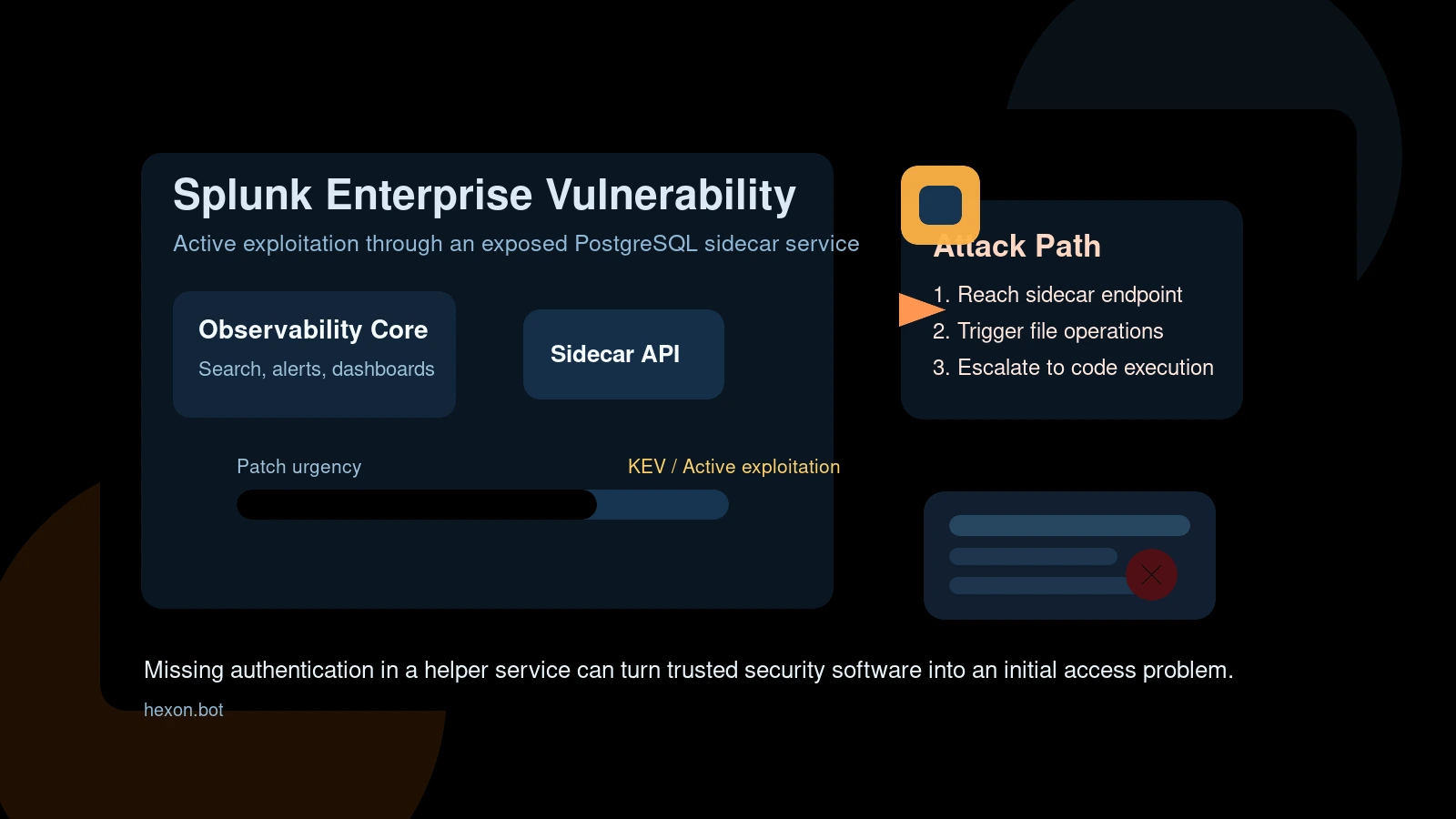
The part worth your attention is not only the CVSS score. It is the design failure behind it. According to Splunk and follow-up technical analysis, an unauthenticated attacker can abuse a PostgreSQL sidecar service endpoint to perform file operations that researchers showed can lead to remote code execution. When the product in question sits close to your monitoring and detection workflow, that becomes more than another patch notice.
Key Stat: BleepingComputer said CISA put CVE-2026-20253 into the Known Exploited Vulnerabilities catalog on June 19 after Splunk confirmed limited exploitation in the wild.
Why the Splunk Enterprise vulnerability matters now
The freshness gate on this story is clean. The main public hook is BleepingComputer's June 19, 2026 report, published after Splunk updated its advisory and after CISA moved the issue into KEV-driven patch priority. That sequence changes the story from "critical bug disclosed" to "critical bug with active exploitation pressure and a hard response clock."
It also makes this different from generic patch coverage. Security teams already live under constant patch fatigue. What cuts through that noise is evidence that attackers are moving fast enough to weaponize an exposed trust boundary in a product used for security visibility, data analysis, and incident response. That is exactly what happened here.
If your team runs Splunk Enterprise on affected versions, the real question is not whether this headline feels dramatic. The real question is whether a product meant to help detect intrusions can itself become an initial foothold before defenders finish their regular change window.
Key Takeaway: This is not mainly a "Splunk bug" story. It is a lesson in how adjacent services, helper components, and sidecars can quietly widen your attack surface inside trusted platforms.
What CVE-2026-20253 actually exposes
Splunk's advisory describes the flaw as unauthenticated arbitrary file creation and truncation in a PostgreSQL sidecar service endpoint affecting Splunk Enterprise 10.0.0 through 10.0.6 and 10.2.0 through 10.2.3. Fixed versions are 10.0.7, 10.2.4, and later, while 10.4 and versions 9.4 and earlier are not affected.
That description sounds serious, but still abstract. The clearer interpretation came from WatchTowr's technical work and supporting write-ups from SecurityWeek and runZero. Researchers showed that the sidecar service could be abused to interact with attacker-controlled database content in ways that enable controlled file writes and eventual remote code execution on vulnerable systems.
Why the sidecar detail matters
A lot of enterprise products now ship with nearby services that make the main platform easier to operate. That might mean a database helper, an indexing helper, a message bus, a local API, or some other component that feels "internal" even when it affects exposed behavior.
The risk is simple: defenders often review the main application and its admin interface more carefully than the supporting pieces around it. Attackers do the opposite. They look for the helper process nobody mentally classifies as the front door.
In this case, Splunk's own advisory says the problem exists because the PostgreSQL sidecar endpoint lacked authentication controls. That should make every defender pause. Missing authentication on a network-reachable service inside a high-trust platform is exactly the kind of issue that turns a supporting component into the real entry point.
Common Mistake: Treating sidecars and service companions as implementation details instead of first-class attack surfaces. If they listen, parse, restore, sync, or proxy, they deserve threat modeling too.
Why this is bigger than another patch alert
There are already plenty of exploited vulnerability stories this month. What makes this one especially worth covering is where it lands in the stack. Splunk is not just another business application. In many organizations it helps hold together detection, triage, search, audit, and security operations workflows.
That means the impact discussion should go beyond "apply the update." A compromise here can create uncomfortable second-order problems:
- attackers may gain code execution on a highly trusted analytics platform
- defenders may lose confidence in the integrity of monitoring or alert data
- incident responders may need to treat the logging plane itself as a potentially compromised system
- change delays become riskier because the target is already attractive and widely deployed
This is why the story belongs next to earlier Hexon coverage such as Trend Micro Apex One zero-day security tool attack path, FortiClient EMS vulnerability infostealer attack, and FortiBleed Fortinet VPN credentials leak. The common thread is not vendor branding. It is what happens when products that sit near trust, detection, or remote access become attacker leverage.
There is also a prioritization lesson here. Teams often reserve their fastest response for identity systems, internet-facing apps, and remote access gateways. They should. But they also need to move quickly when a high-trust security platform gains a pre-auth exploitation path, because the blast radius can expand far beyond the host itself.
What makes exploitation especially uncomfortable
The public reporting suggests a few details security leaders should care about right away.
First, the flaw moved from disclosure to public exploitation pressure quickly. Splunk published the advisory on June 10. WatchTowr published technical detail and PoC guidance on June 12. Splunk then updated the advisory on June 18 to acknowledge limited exploitation, and CISA pushed the flaw into the KEV catalog the same day. By June 19, the story had become a patch-now operational issue rather than a background engineering task.
Second, exploitability appears tied to product configuration and deployment style more than many administrators may assume. WatchTowr noted that some deployments are more exposed than others, and called out Splunk Enterprise on AWS as vulnerable out of the box when the PostgreSQL sidecar is installed and enabled by default. That matters because it shifts the risk from niche edge case to plausible enterprise reality.
Third, Splunk's own workaround carries tradeoffs. If you cannot patch immediately, the vendor says you can disable the PostgreSQL sidecar service. But that can break Edge Processor, OpAmp, or SPL2 data pipelines on affected instances. In other words, even the mitigation can force teams into an operational trade between reducing attack surface and preserving data flow.
Pro Tip: If your emergency mitigation changes telemetry behavior, document that decision immediately. Losing clean data during a rushed security response creates its own investigation problem later.
What defenders should do in the next 24 hours
If your organization uses Splunk Enterprise, this is a short-fuse validation exercise, not a reading assignment.
1. Identify affected versions fast
Confirm whether you run:
- Splunk Enterprise 10.0.0 through 10.0.6
- Splunk Enterprise 10.2.0 through 10.2.3
If yes, move those instances into your highest-priority queue. If you are unsure where all deployments live, use your software inventory and logging ownership map to find managed and semi-forgotten nodes quickly.
2. Patch before the maintenance window argument starts
Upgrade to:
- 10.0.7 or later
- 10.2.4 or later
If you already treat KEV-listed issues as top priority, this should be automatic. If you do not, that policy gap is now part of the problem.
3. Use the workaround only with eyes open
Splunk says disabling the PostgreSQL sidecar service reduces the attack surface if you cannot patch immediately. That is useful, but it is not free. Review whether the affected instance depends on Edge Processor, OpAmp, or SPL2 data pipelines before you flip the switch, and log any operational impact clearly.
4. Hunt for exposure and post-patch confidence
Do not stop at version upgrades. Review:
- internet reachability to the affected instances
- unexpected file changes or suspicious process behavior around the Splunk host
- unusual sidecar or restore-related activity if your telemetry allows it
- recent admin actions that may hide emergency changes without documentation
This is also a good time to verify whether your detection stack would show you tampering on the platform that stores and searches your event data.
5. Revisit trust assumptions around security platforms
Many teams harden apps used by employees more aggressively than the tools used by defenders. That is backwards. Products with broad visibility and operational trust deserve the same urgency you would apply to identity, VPN, and remote management systems.
For readers tracking that broader pattern, Hexon's posts on Windows Netlogon active exploitation and ServiceNow customer data exposure reach the same conclusion from different angles: the biggest risk often appears where organizations assume the platform is too central or too familiar to fail in an interesting way.
The strategic lesson for security teams
The most useful lesson from the Splunk story is not "patch critical flaws faster," even though that is obviously true. The deeper lesson is that supporting services inherit the trust of the parent platform, whether or not they have earned the same scrutiny.
That matters more every year because enterprise products keep becoming ecosystems rather than single binaries. They ship with sidecars, agents, message queues, local APIs, embedded databases, plugin systems, and cloud-connected management features. Every one of those pieces can quietly become the easiest path in.
Security teams should respond by tightening a few habits:
- inventory companion services, not just primary applications
- classify helper components as exposed attack surface when they handle network traffic or file operations
- test whether emergency mitigations break core workflows before the next crisis
- give security tooling the same hardening discipline applied to remote access and identity platforms
This is also why the Splunk Enterprise vulnerability is a better strategic story than a generic exploit headline. It exposes a very modern enterprise problem. Complexity accumulates next to trusted software, and organizations often keep granting that complexity the benefit of the doubt until an attacker proves it should not have had it.
Key Stat: Splunk's advisory says versions 9.4 and earlier are not affected, which means version drift can make newer deployments riskier than older ones when supporting components change the trust model.
Final takeaway
The Splunk Enterprise vulnerability deserves immediate attention because the freshness is real, the exploitation pressure is real, and the operational lesson is bigger than one product. A missing authentication control in a sidecar service turned a trusted security data platform into a possible pre-auth entry point, then forced defenders into a rapid patch-or-mitigate decision with tradeoffs.
If you run affected Splunk Enterprise versions, patch first and validate second. Then take the longer view. Ask which helper services inside your security stack are still being treated like invisible plumbing instead of exposed software with their own threat profile. That is the question this story leaves behind after the patch is done.