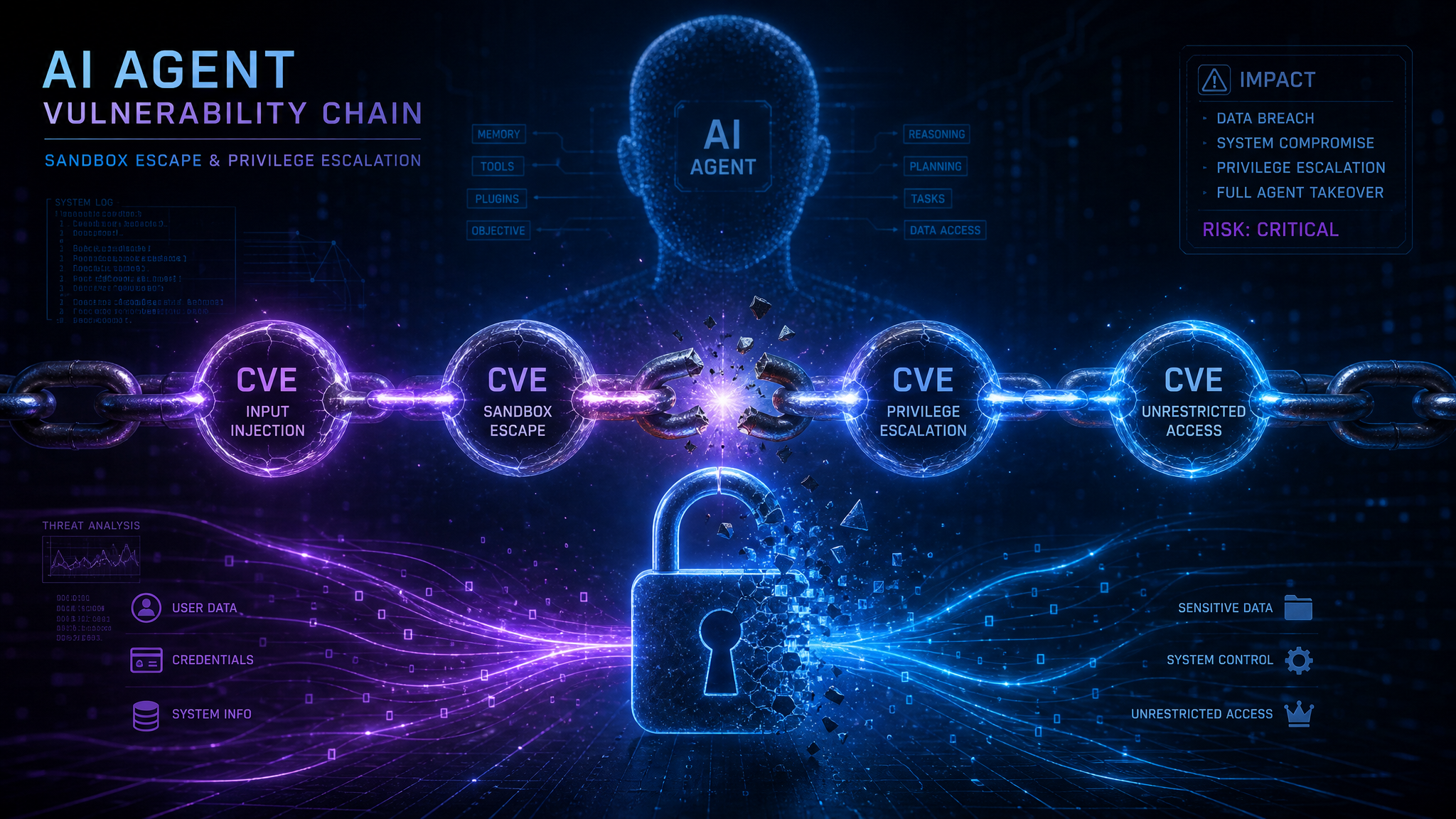
Cyera researchers just dropped a bombshell on the AI agent security landscape. Four chainable vulnerabilities in OpenClaw - collectively dubbed Claw Chain - allow attackers to weaponize the agent's own sandbox, steal sensitive data, escalate privileges, and establish persistent backdoors on compromised hosts. The most severe flaw, CVE-2026-44112, carries a CVSS score of 9.6 and enables sandbox escape through a time-of-check/time-of-use race condition that traditional security controls struggle to detect.
This is not a theoretical research exercise. OpenClaw has more than 3.2 million users, is integrated with ChatGPT subscriptions through OpenAI, and powers enterprise deployments at Nvidia and Tencent. An estimated 245,000 public-facing AI agent servers are potentially exposed. And because each step of the attack chain looks like normal agent behavior, detection is significantly harder than conventional malware.
The disclosure, published on May 15, 2026, comes at a critical moment. Just weeks after Google confirmed the first AI-generated zero-day exploit in the wild and Microsoft unveiled its MDASH agentic AI security system, Claw Chain demonstrates that the platforms enabling the AI revolution are themselves becoming prime attack targets. When the agent is the attack surface, perimeter security becomes almost meaningless.
What Is Claw Chain and Why It Matters Now
Claw Chain is not a single vulnerability. It is a four-stage exploitation chain that transforms a compromised AI agent from a helpful assistant into a full-fledged attack platform. The vulnerabilities were discovered by security researcher Vladimir Tokarev and disclosed by Cyera, affecting all OpenClaw versions prior to 2026.4.22.
Key Stat: The four vulnerabilities span CVE-2026-44112 (CVSS 9.6), CVE-2026-44113 (CVSS 7.7), CVE-2026-44115 (CVSS 8.8), and CVE-2026-44118 (CVSS 7.8). When chained, they create a complete attack path from initial sandbox compromise to persistent host control.
The Attack Chain in Four Steps
The exploitation unfolds methodically, with each stage building on the previous:
- Initial Compromise - A malicious plugin, prompt injection, or compromised external input gains code execution inside the OpenShell managed sandbox
- Data Exfiltration - CVE-2026-44113 and CVE-2026-44115 are exploited to expose credentials, secrets, and sensitive files outside the sandbox boundaries
- Privilege Escalation - CVE-2026-44118 grants owner-level control over the agent runtime by spoofing a client-controlled ownership flag
- Persistence and Backdoors - CVE-2026-44112 plants backdoors, modifies configuration, and establishes persistent control outside the sandbox entirely
Key Takeaway: What makes Claw Chain particularly dangerous is that every step looks like legitimate agent activity. Traditional endpoint detection tools, which rely on identifying anomalous behavior, see an AI agent doing exactly what it was designed to do. The malicious actions are indistinguishable from normal operations.
CVE-2026-44112: The Sandbox Escape That Breaks the Trust Model
The most severe vulnerability in the chain is CVE-2026-44112, a time-of-check/time-of-use race condition in OpenClaw's OpenShell managed sandbox backend. This flaw allows attackers to bypass sandbox restrictions and redirect file writes outside the intended mount root.
How the TOCTOU Race Condition Works
In a properly functioning sandbox, the system validates that a file path is within the allowed directory before permitting a write operation. The check happens, the path is approved, and the write proceeds. But in a TOCTOU vulnerability, an attacker can swap the validated path with a symbolic link pointing to a sensitive system location between the check and the actual write.
The result is that the sandbox believes it is writing to an approved location while the file actually lands in a critical system directory. This is not a new class of vulnerability - TOCTOU flaws have plagued operating systems for decades - but its presence in an AI agent sandbox is particularly concerning because agents are designed to execute code automatically based on external inputs.
Key Stat: CVE-2026-44112 has a CVSS score of 9.6 out of 10, reflecting both the ease of exploitation and the severity of impact. The vulnerability allows attackers to tamper with configuration files, plant backdoors, and establish persistent control over the compromised host.
Why Sandboxes Were Supposed to Prevent This
The entire premise of OpenClaw's OpenShell sandbox is that even if an attacker compromises the agent, they remain trapped inside a restricted environment. The sandbox is supposed to be the last line of defense - the containment layer that prevents a compromised agent from touching the host system.
CVE-2026-44112 breaks that promise. By escaping the sandbox, an attacker gains the same level of access as the agent itself, which typically includes file system access, API credentials, network permissions, and execution privileges. In enterprise deployments, that can mean access to source code repositories, cloud infrastructure, internal databases, and sensitive configuration files.
Common Mistake: Assuming that sandboxing alone is sufficient protection for AI agents. Claw Chain proves that sandbox implementations can contain critical flaws, and when those flaws are chained with privilege escalation vulnerabilities, the entire security model collapses.
CVE-2026-44118: The Ownership Flag That Should Never Have Been Trusted
While CVE-2026-44112 provides the escape route, CVE-2026-44118 provides the keys to the kingdom. This improper access control vulnerability allows non-owner loopback clients to impersonate an owner and gain control over gateway configuration, cron scheduling, and execution environment management.
The senderIsOwner Design Flaw
The root cause of CVE-2026-44118 is almost embarrassingly simple from a security architecture perspective. OpenClaw trusted a client-controlled ownership flag called senderIsOwner to determine whether a caller was authorized for owner-only tools. The problem? This flag was never validated against the authenticated session.
Any non-owner loopback client could simply set senderIsOwner to true and immediately gain owner-level privileges. There was no server-side verification, no token validation, no cryptographic proof of ownership. Just a boolean flag that the client controlled entirely.
"The MCP loopback runtime now issues separate owner and non-owner bearer tokens and derives senderIsOwner exclusively from which token authenticated the request," OpenClaw stated in its advisory. "The spoofable sender-owner header is no longer emitted or trusted."
What Owner-Level Control Means in Practice
Owner-level access in OpenClaw is not a minor permission elevation. It grants control over:
- Gateway configuration - Modifying how the agent connects to external services and APIs
- Cron scheduling - Setting up persistent automated tasks that run on defined intervals
- Execution environment management - Changing the runtime environment, installing packages, and modifying system paths
An attacker with owner-level control can reconfigure the agent to exfiltrate data on a schedule, install additional malicious components, or modify the environment to hide their presence from security tools.
Pro Tip: The fix for CVE-2026-44118 - issuing separate bearer tokens for owners and non-owners - is exactly the kind of architectural change that should have been in place from day one. When designing authentication for AI agents, never trust client-supplied identity claims without server-side validation.
%22%2F%3E%0A%20%20%3Ccircle%20cx%3D%221270%22%20cy%3D%22180%22%20r%3D%22210%22%20fill%3D%22rgba(123%2C%20215%2C%20255%2C%200.18)%22%2F%3E%0A%20%20%3Ccircle%20cx%3D%22310%22%20cy%3D%22710%22%20r%3D%22250%22%20fill%3D%22rgba(52%2C%20211%2C%20153%2C%200.10)%22%2F%3E%0A%20%20%3Cpath%20d%3D%22M160%20708C340%20574%20498%20531%20653%20566C828%20605%20941%20504%201086%20418C1191%20355%201308%20317%201440%20332%22%20stroke%3D%22%237bd7ff%22%20stroke-width%3D%2210%22%20stroke-linecap%3D%22round%22%20opacity%3D%220.85%22%2F%3E%0A%20%20%3Cpath%20d%3D%22M160%20640H1440%22%20stroke%3D%22rgba(255%2C255%2C255%2C0.08)%22%20stroke-width%3D%222%22%2F%3E%0A%20%20%3Cpath%20d%3D%22M160%20298H1440%22%20stroke%3D%22rgba(255%2C255%2C255%2C0.08)%22%20stroke-width%3D%222%22%2F%3E%0A%20%20%3Crect%20x%3D%22160%22%20y%3D%22142%22%20width%3D%22174%22%20height%3D%2236%22%20rx%3D%2218%22%20fill%3D%22rgba(123%2C%20215%2C%20255%2C%200.18)%22%20stroke%3D%22%237bd7ff%22%2F%3E%0A%20%20%3Ctext%20x%3D%22247%22%20y%3D%22166%22%20text-anchor%3D%22middle%22%20fill%3D%22%23D9F4FF%22%20font-size%3D%2218%22%20font-family%3D%22Arial%2C%20Helvetica%2C%20sans-serif%22%20letter-spacing%3D%222%22%3EAI%20SECURITY%3C%2Ftext%3E%0A%20%20%3Ctext%20x%3D%22160%22%20y%3D%22392%22%20fill%3D%22%23F7FBFF%22%20font-size%3D%2266%22%20font-weight%3D%22700%22%20font-family%3D%22Arial%2C%20Helvetica%2C%20sans-serif%22%3EThe%20Supporting%20Flaws%3A%20Data%3C%2Ftext%3E%0A%20%20%3Ctext%20x%3D%22160%22%20y%3D%22470%22%20fill%3D%22%23F7FBFF%22%20font-size%3D%2266%22%20font-weight%3D%22700%22%20font-family%3D%22Arial%2C%20Helvetica%2C%20sans-serif%22%3ETheft%20Through%20Clever%3C%2Ftext%3E%0A%20%20%3Ctext%20x%3D%22160%22%20y%3D%22554%22%20fill%3D%22%23A8B8C8%22%20font-size%3D%2228%22%20font-family%3D%22Arial%2C%20Helvetica%2C%20sans-serif%22%3EClaw%20Chain%20OpenClaw%20Vulnerabilities%3A%20How%3C%2Ftext%3E%0A%20%20%3Crect%20x%3D%221080%22%20y%3D%22420%22%20width%3D%22274%22%20height%3D%22182%22%20rx%3D%2222%22%20fill%3D%22%230E2231%22%20stroke%3D%22rgba(255%2C255%2C255%2C0.10)%22%2F%3E%0A%20%20%3Crect%20x%3D%221120%22%20y%3D%22458%22%20width%3D%22112%22%20height%3D%2218%22%20rx%3D%229%22%20fill%3D%22%237bd7ff%22%20opacity%3D%220.9%22%2F%3E%0A%20%20%3Crect%20x%3D%221120%22%20y%3D%22498%22%20width%3D%22180%22%20height%3D%2212%22%20rx%3D%226%22%20fill%3D%22rgba(255%2C255%2C255%2C0.2)%22%2F%3E%0A%20%20%3Crect%20x%3D%221120%22%20y%3D%22526%22%20width%3D%22146%22%20height%3D%2212%22%20rx%3D%226%22%20fill%3D%22rgba(255%2C255%2C255%2C0.14)%22%2F%3E%0A%20%20%3Crect%20x%3D%221120%22%20y%3D%22554%22%20width%3D%2288%22%20height%3D%2212%22%20rx%3D%226%22%20fill%3D%22rgba(255%2C255%2C255%2C0.12)%22%2F%3E%0A%20%20%3Ccircle%20cx%3D%221340%22%20cy%3D%22522%22%20r%3D%2244%22%20fill%3D%22rgba(123%2C%20215%2C%20255%2C%200.18)%22%20stroke%3D%22%237bd7ff%22%2F%3E%0A%20%20%3Cpath%20d%3D%22M1322%20522L1336%20536L1360%20506%22%20stroke%3D%22%237bd7ff%22%20stroke-width%3D%228%22%20stroke-linecap%3D%22round%22%20stroke-linejoin%3D%22round%22%2F%3E%0A%20%20%3Ctext%20x%3D%22160%22%20y%3D%22748%22%20fill%3D%22%237BD7FF%22%20font-size%3D%2222%22%20font-family%3D%22Arial%2C%20Helvetica%2C%20sans-serif%22%20letter-spacing%3D%223%22%3EHEXON%20%2F%2F%20SUPPORTING%20VISUAL%3C%2Ftext%3E%0A%3C%2Fsvg%3E)
The Supporting Flaws: Data Theft Through Clever Bypasses
The remaining two vulnerabilities in the chain, CVE-2026-44113 and CVE-2026-44115, provide the data access that makes the full exploitation chain worthwhile.
CVE-2026-44113: Reading Outside the Sandbox
CVE-2026-44113 is a companion TOCTOU race condition to CVE-2026-44112, but targeting read operations rather than writes. Using the same symbolic link swap technique, attackers can redirect file reads outside the allowed mount root, exposing system files, credentials, and internal artifacts that the agent was never meant to access.
While this vulnerability alone does not provide code execution or privilege escalation, it is a critical enabler for the full chain. By reading sensitive configuration files, API keys, and credential stores, an attacker can gather the intelligence needed to escalate privileges through CVE-2026-44118 and establish persistence through CVE-2026-44112.
CVE-2026-44115: The Heredoc Allowlist Bypass
CVE-2026-44115 exploits an incomplete list of disallowed inputs in OpenClaw's command validation system. The vulnerability allows attackers to bypass allowlist validation by embedding shell expansion tokens inside a heredoc body - a here document that passes input to commands.
The attack works because OpenClaw's validation checks commands at the surface level, before shell expansion occurs. A command that appears safe during validation can contain hidden shell expansion tokens that execute arbitrary code at runtime. This allows attackers to run unapproved commands that would otherwise be blocked by the allowlist.
Key Stat: CVE-2026-44115 carries a CVSS score of 8.8, reflecting the ability to execute arbitrary commands and access sensitive environment variables including API keys, tokens, and credentials.
The Scale of Exposure: 245,000 Public Servers at Risk
The technical severity of Claw Chain is matched by the scale of its potential impact. OpenClaw's rapid adoption - driven by its ChatGPT integration and enterprise partnerships - has created an attack surface that rivals some of the most widely deployed enterprise software platforms.
The OpenClaw User Base
OpenClaw has grown from a niche open-source project to a mainstream AI agent platform with more than 3.2 million users. It is integrated directly into ChatGPT subscriptions through OpenAI, meaning that millions of users have OpenClaw capabilities available without necessarily understanding the security implications.
Enterprise adoption is equally significant. Nvidia built NemoClaw, an enterprise security layer, on top of OpenClaw in partnership with Cisco, CrowdStrike, Google, and Microsoft Security. Tencent deployed ClawPro for enterprise AI agents. These are not experimental deployments - they are production platforms handling sensitive corporate data.
Publicly Exposed Instances
The most alarming exposure metric is the estimated 245,000 publicly accessible OpenClaw instances identified by security researchers. These are not internal deployments behind corporate firewalls. They are internet-facing servers that attackers can scan, fingerprint, and target directly.
A significant portion of the installed base is running older, unpatched versions. Attackers have been targeting known OpenClaw vulnerabilities in versions prior to 2026.1.30 since at least February 2026, and the Claw Chain vulnerabilities affect all versions before 2026.4.22.
Key Takeaway: The combination of widespread deployment, public exposure, and unpatched instances creates a target-rich environment for attackers. Claw Chain is not just a vulnerability disclosure - it is an active threat to hundreds of thousands of production systems.
Why Traditional Security Tools Struggle to Detect Claw Chain
Perhaps the most concerning aspect of Claw Chain is not what the vulnerabilities do, but how invisible they are to conventional security controls. Cyera explicitly noted that each step looks like normal agent behavior to traditional detection systems.
The Trusted Process Problem
AI agents are designed to execute code, access files, and make API calls. That is their purpose. When an attacker exploits Claw Chain, they are not injecting foreign malware or spawning suspicious processes. They are using the agent's own legitimate capabilities to perform actions that the agent is explicitly authorized to do.
A file read by an AI agent looks like normal operation. A configuration change by an AI agent looks like normal operation. An API call by an AI agent looks like normal operation. Traditional endpoint detection and response tools, which rely on identifying anomalous process behavior, have no baseline for distinguishing malicious agent activity from legitimate agent activity.
The Detection Gap
"By weaponizing the agent's own privileges, an adversary moves through data access, privilege escalation, and persistence - using the agent as their hands inside the environment," Cyera explained. "Each step looks like normal agent behavior to traditional controls, broadening blast radius and making detection significantly harder."
This detection gap is not unique to OpenClaw. It is a fundamental challenge for the entire AI agent security model. When the most privileged entity in an environment is software that executes instructions from external sources - including user prompts, plugin inputs, and third-party APIs - distinguishing legitimate from malicious activity becomes an architectural problem, not a detection problem.
Pro Tip: Organizations deploying AI agents need to implement behavioral baselining specifically for agent activity, not just generic endpoint behavior. Monitor for unusual patterns in agent file access, configuration changes, and API calls rather than relying on traditional malware signatures.
%22%2F%3E%0A%20%20%3Ccircle%20cx%3D%221270%22%20cy%3D%22180%22%20r%3D%22210%22%20fill%3D%22rgba(167%2C%20139%2C%20250%2C%200.18)%22%2F%3E%0A%20%20%3Ccircle%20cx%3D%22310%22%20cy%3D%22710%22%20r%3D%22250%22%20fill%3D%22rgba(52%2C%20211%2C%20153%2C%200.10)%22%2F%3E%0A%20%20%3Cpath%20d%3D%22M160%20708C340%20574%20498%20531%20653%20566C828%20605%20941%20504%201086%20418C1191%20355%201308%20317%201440%20332%22%20stroke%3D%22%23a78bfa%22%20stroke-width%3D%2210%22%20stroke-linecap%3D%22round%22%20opacity%3D%220.85%22%2F%3E%0A%20%20%3Cpath%20d%3D%22M160%20640H1440%22%20stroke%3D%22rgba(255%2C255%2C255%2C0.08)%22%20stroke-width%3D%222%22%2F%3E%0A%20%20%3Cpath%20d%3D%22M160%20298H1440%22%20stroke%3D%22rgba(255%2C255%2C255%2C0.08)%22%20stroke-width%3D%222%22%2F%3E%0A%20%20%3Crect%20x%3D%22160%22%20y%3D%22142%22%20width%3D%22174%22%20height%3D%2236%22%20rx%3D%2218%22%20fill%3D%22rgba(167%2C%20139%2C%20250%2C%200.18)%22%20stroke%3D%22%23a78bfa%22%2F%3E%0A%20%20%3Ctext%20x%3D%22247%22%20y%3D%22166%22%20text-anchor%3D%22middle%22%20fill%3D%22%23D9F4FF%22%20font-size%3D%2218%22%20font-family%3D%22Arial%2C%20Helvetica%2C%20sans-serif%22%20letter-spacing%3D%222%22%3EAI%20SECURITY%3C%2Ftext%3E%0A%20%20%3Ctext%20x%3D%22160%22%20y%3D%22392%22%20fill%3D%22%23F7FBFF%22%20font-size%3D%2266%22%20font-weight%3D%22700%22%20font-family%3D%22Arial%2C%20Helvetica%2C%20sans-serif%22%3EThe%20Broader%20Context%3A%20AI%3C%2Ftext%3E%0A%20%20%3Ctext%20x%3D%22160%22%20y%3D%22470%22%20fill%3D%22%23F7FBFF%22%20font-size%3D%2266%22%20font-weight%3D%22700%22%20font-family%3D%22Arial%2C%20Helvetica%2C%20sans-serif%22%3EAgent%20Security%20Under%3C%2Ftext%3E%0A%20%20%3Ctext%20x%3D%22160%22%20y%3D%22554%22%20fill%3D%22%23A8B8C8%22%20font-size%3D%2228%22%20font-family%3D%22Arial%2C%20Helvetica%2C%20sans-serif%22%3EClaw%20Chain%20OpenClaw%20Vulnerabilities%3A%20How%3C%2Ftext%3E%0A%20%20%3Crect%20x%3D%221080%22%20y%3D%22420%22%20width%3D%22274%22%20height%3D%22182%22%20rx%3D%2222%22%20fill%3D%22%230E2231%22%20stroke%3D%22rgba(255%2C255%2C255%2C0.10)%22%2F%3E%0A%20%20%3Crect%20x%3D%221120%22%20y%3D%22458%22%20width%3D%22112%22%20height%3D%2218%22%20rx%3D%229%22%20fill%3D%22%23a78bfa%22%20opacity%3D%220.9%22%2F%3E%0A%20%20%3Crect%20x%3D%221120%22%20y%3D%22498%22%20width%3D%22180%22%20height%3D%2212%22%20rx%3D%226%22%20fill%3D%22rgba(255%2C255%2C255%2C0.2)%22%2F%3E%0A%20%20%3Crect%20x%3D%221120%22%20y%3D%22526%22%20width%3D%22146%22%20height%3D%2212%22%20rx%3D%226%22%20fill%3D%22rgba(255%2C255%2C255%2C0.14)%22%2F%3E%0A%20%20%3Crect%20x%3D%221120%22%20y%3D%22554%22%20width%3D%2288%22%20height%3D%2212%22%20rx%3D%226%22%20fill%3D%22rgba(255%2C255%2C255%2C0.12)%22%2F%3E%0A%20%20%3Ccircle%20cx%3D%221340%22%20cy%3D%22522%22%20r%3D%2244%22%20fill%3D%22rgba(167%2C%20139%2C%20250%2C%200.18)%22%20stroke%3D%22%23a78bfa%22%2F%3E%0A%20%20%3Cpath%20d%3D%22M1322%20522L1336%20536L1360%20506%22%20stroke%3D%22%23a78bfa%22%20stroke-width%3D%228%22%20stroke-linecap%3D%22round%22%20stroke-linejoin%3D%22round%22%2F%3E%0A%20%20%3Ctext%20x%3D%22160%22%20y%3D%22748%22%20fill%3D%22%237BD7FF%22%20font-size%3D%2222%22%20font-family%3D%22Arial%2C%20Helvetica%2C%20sans-serif%22%20letter-spacing%3D%223%22%3EHEXON%20%2F%2F%20SUPPORTING%20VISUAL%3C%2Ftext%3E%0A%3C%2Fsvg%3E)
The Broader Context: AI Agent Security Under Scrutiny
Claw Chain arrives at a pivotal moment for AI agent security. The past month has seen a cascade of disclosures, attacks, and defensive initiatives that collectively signal a maturing threat landscape.
From CVE-2026-25253 to ClawHavoc
OpenClaw's security track record has been under pressure since January 2026, when CVE-2026-25253 allowed any website to silently connect to the agent's local server through an unvalidated WebSocket, enabling cross-site hijacking into full code execution. That was followed by the ClawHavoc supply chain campaign, which targeted OpenClaw users with information-stealing malware distributed through the ClawHub skill marketplace.
A Koi Security audit of ClawHub found 341 malicious skills out of 2,857 available entries, with attacks designed to steal credentials, open reverse shells, and hijack agents for cryptocurrency mining. The IBM X-Force team has since published research on what OpenClaw reveals about broader agentic AI security risks.
The Enterprise Response
Nvidia's NemoClaw, launched in March 2026, was specifically designed to address some of these structural security concerns by adding sandbox orchestration, privacy guardrails, and security hardening on top of OpenClaw. But NemoClaw operates at the infrastructure level, not the application level, and the Claw Chain vulnerabilities sit inside OpenClaw's own sandbox implementation.
This means that even NemoClaw-hardened deployments would have been vulnerable before the 2026.4.22 patch. Enterprise security layers can add defense in depth, but they cannot compensate for fundamental flaws in the underlying platform.
Key Stat: The Claw Chain disclosure is the third major OpenClaw security event in 2026, following the January WebSocket vulnerability and the February ClawHavoc supply chain attack. The frequency and severity of these disclosures suggest that AI agent security is still in its early maturity phase.
What Organizations Should Do Right Now
OpenClaw has patched all four vulnerabilities in version 2026.4.22. The immediate priority is updating all instances, but the broader security implications require a more comprehensive response.
Immediate Actions
- Update to OpenClaw 2026.4.22 immediately on all instances, including development, staging, and production environments
- Audit publicly exposed instances and restrict network access to agents that do not require internet-facing deployment
- Review agent permissions and apply the principle of least privilege - agents should not have access to sensitive credentials, production databases, or critical infrastructure unless absolutely necessary
- Scan for indicators of compromise including unauthorized configuration changes, unexpected cron jobs, and unusual file access patterns
Longer-Term Hardening
- Implement agent-specific behavioral monitoring that establishes baselines for normal agent activity and alerts on deviations
- Segment agent deployments so that a compromised agent cannot easily move laterally to critical systems
- Review plugin and skill sources - only install plugins from trusted sources and audit existing plugin permissions regularly
- Consider alternative agent platforms for high-security environments where OpenClaw's security track record may not meet risk tolerance requirements
Common Mistake: Treating AI agents as just another application. Agents have unique security characteristics - they execute code automatically, interact with external inputs unpredictably, and often operate with high privileges. They require security models designed specifically for autonomous software, not conventional application security checklists.
What This Means for the Future of AI Security
Claw Chain is more than a set of vulnerabilities in a single platform. It is a case study in the security challenges that will define the AI agent era.
The Agent as Attack Surface
Traditional cybersecurity assumes that users and applications are separate from the attack surface. Users interact with applications; applications process data; attackers target vulnerabilities in the software stack. AI agents collapse this model. The agent is simultaneously the user interface, the application, and the execution environment. When the agent is compromised, the attacker gains everything the agent can access.
The Trust Inversion
Conventional security models trust users and verify software. AI agents invert this model - the software is trusted to act on behalf of the user, often with minimal oversight. Claw Chain demonstrates what happens when that trust is misplaced. The agent's own privileges become the attacker's privileges. The agent's own access becomes the attacker's access.
The Detection Challenge
Perhaps the most lasting lesson from Claw Chain is the detection challenge it poses. When attackers use legitimate agent capabilities for malicious purposes, there is no malware to detect, no anomalous process to flag, no suspicious network traffic to block. The attack looks like normal operations because, from the agent's perspective, it is normal operations.
Key Stat: Cyera's research explicitly warns that Claw Chain "broadens blast radius and makes detection significantly harder" because each step looks like normal agent behavior. This is not a temporary limitation of current tools. It is a fundamental characteristic of agent-based attacks that security architectures must account for.
Conclusion
The Claw Chain vulnerabilities are a wake-up call for every organization deploying AI agents. Four chainable flaws - a TOCTOU race condition, an improper access control, a command validation bypass, and a companion read escape - transform a compromised agent from a productivity tool into a persistent threat platform.
With 245,000 public servers exposed, 3.2 million users potentially at risk, and detection capabilities that struggle to distinguish malicious from legitimate agent activity, the security implications extend far beyond OpenClaw itself. They touch on the fundamental question of how to secure software that is designed to be autonomous, privileged, and unpredictable.
OpenClaw has patched the vulnerabilities. The question now is whether the organizations running those 245,000 public instances - and the millions more behind firewalls - will apply those patches before attackers apply the exploits. And whether the broader AI agent industry will treat Claw Chain as an isolated incident or as a signal that agent security needs to be redesigned from the ground up.
The AI revolution is not slowing down. Agents are becoming more capable, more integrated, and more privileged. Claw Chain is a reminder that the platforms enabling this revolution must be secured with the same rigor applied to operating systems and cloud infrastructure - not as an afterthought, but as a foundational requirement. The organizations that internalize this lesson will be the ones that survive the transition to an agent-driven digital economy.